

A few months back, we needed new rooftop units (RTUs) for the store’s HVAC system. Before I called anyone, I did what any of us would do. I looked up the prices online.
They were there. Carrier, Daikin, Trane. Entry-level commercial units starting around $5,000, larger ones running roughly $15,000 to $20,000. I knew the field before the conversation started with anyone. Then I called a distributor, bought the units from them, and had them delivered to the store. No part of that purchase happened outside the normal channel. The only difference was that I walked in knowing the floor.
Now think about the machines on the floor below those RTUs. A small commercial washer costs about what a small rooftop unit costs. Same building, same order of magnitude of money. But if you want to know what that washer costs before a distributor tells you, there is nowhere to look publicly.
One roof, one floor, two information worlds. That contrast has been sitting with me for many months, and I want to walk through what's actually underneath it.
The architecture of not knowing
Start with how equipment pricing in our industry works, because the structure is more interesting than any complaint about it.
For the major brands, neither the manufacturer nor its distribution network publishes model-level prices publicly. Industry blogs float wide secondhand ranges, spanning $1,800 to over $30,000 for a single category, and the width of those ranges is its own kind of answer. The first real number a buyer sees still arrives inside a sales conversation. And a list price does exist. Manufacturers provide one to their distributors as the basis for markup.¹ It just never reaches the buyer. That's the first piece.
The second piece is territory. Distribution in our industry runs on exclusive territories, which means the second quote you'd naturally want, the same machine from a different distributor, is structurally unavailable in your market. Under federal antitrust guidance, a manufacturer acting on its own can legally set up exclusive territories.² This isn't misconduct. It's a legacy dealer model, the same architecture the car business ran on for a century.
The third piece closes the loop. Since you can't compare the same brand against itself, your only check is a cross-brand quote. And cross-brand comparisons get answered with a differentiation claim. Our machine is better, that's why it costs more. Better by what pricing standard? Without a published baseline anywhere, the claim can't be tested. It can only be believed or not believed.
Put the three together and something clicks into focus. A buyer in our industry isn't bad at price research. The triangulation for every other purchase teaches us to do is unable to be done here.
I watched a version of this conversation play out in an industry Facebook group recently, dozens of owner/operators, distributors and manufactures employees. What struck me was that the sharpest frustration in that thread wasn't about price levels at all. One owner/operator put it in a way I haven't been able to get out my head. He wasn't complaining about the price, he said. He could accept the price. What he couldn't accept was having no idea where the floor was.
And the stakes here aren't small. Across published startup cost breakdowns, equipment runs 40 to 60 percent of the total investment in a new store.³ From my own builds and speaking with other owners/operators, roughly 50 washers and 50 dryers puts you somewhere in the range of $800,000 to $1.2 million on machines alone (varying by brand, make and models). The single largest line item in the largest investment many of us will ever make outside our homes is the one line item with no researchable price.
The industry's case, taken seriously
Before going further, the case for the current model deserves a fair hearing, because it's not an empty one.
Equipment prices genuinely move. Steel, freight, tariffs, currency. A price printed in January can be wrong by June, and a published number that's wrong is arguably worse than no number at all.
Equipment quotes are also project quotes. A distributor isn't handing you a machine off a shelf. The quote bundles freight, installation, service relationships, sometimes financing. Distributor economics are project economics, not product economics, and a bare machine price tells you less about your real cost than a car sticker tells you about a car.
There's a relationship argument too. These machines run 10 to 15 years. The distributor who installs them is the one who answers the phone when a bearing goes at 7 a.m. on a Saturday. A pricing model built around conversation rather than a catalog keeps that relationship at the center of the sale.
And finally there's the practical point. No major brand publishes, so publishing isn't a competitive lever anyone is measured against. The model persists in part because it's simply the water everyone swims in.
Every one of those arguments is real. Which is what makes the next part so interesting.
The most volatile prices on earth are the most public
Take the strongest argument first, that prices move too much to publish. Now look at the markets where prices move the most.
Beef prices move daily. The USDA publishes the National Daily Boxed Beef Cutout every business day, actual negotiated prices and volumes, free to anyone.⁴
Soybeans trade continuously on the Chicago Board of Trade. Frozen concentrated orange juice, a product whose price swings with Florida weather, trades on ICE as the world benchmark contract for the entire market.⁵ Lumber trades on the CME.
Then there's steel, and steel is the one worth sitting with. Steel is an industrial input whose price moves constantly, sold through distributors and service centers, in an industry where every deal is still negotiated. And the CRU (Commodities Research Unit) hot-rolled coil index is published every week and referenced in over 95 percent of physical hot-rolled coil contracts in the United States.⁶ Federal producer price data for steel runs back to 1982, public, chartable by anyone. Steel kept its sales channel. Steel kept negotiation. Steel kept relationships. And steel publishes the benchmark anyway.
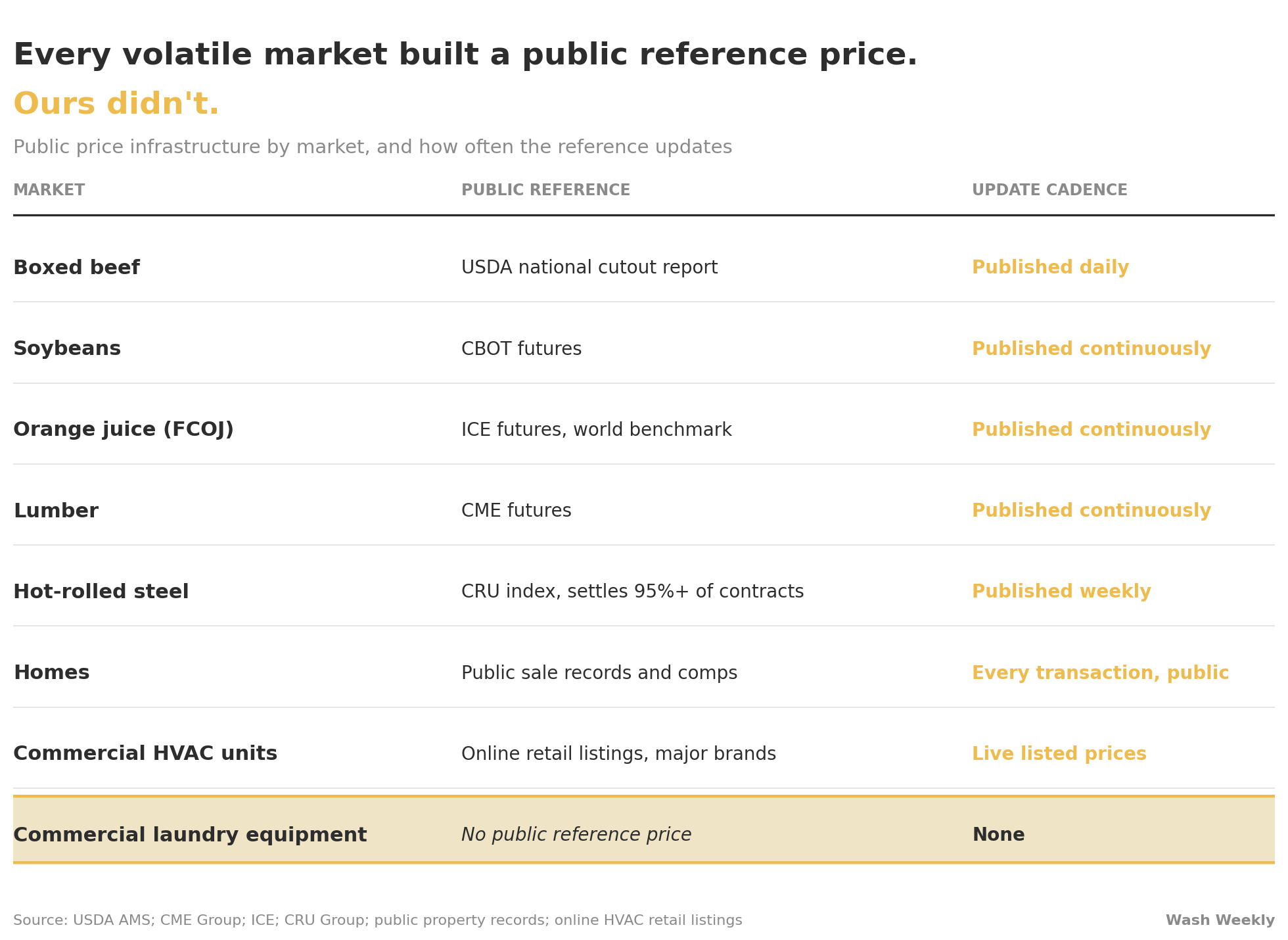
So the pattern runs opposite to the argument. Volatility didn't prevent price transparency in those markets. Volatility is what built the transparency infrastructure, because markets handle moving prices with visible prices. The commodities one points to as the reason a price can't be published are the most publicly priced things in the economy.
The steel version of the lesson travels well. Publish the benchmark, negotiate the deal. The HVAC version travels even better for us, because it's our exact category. Heavy commercial equipment, sold through distributors, professionally installed, prices researchable before the first phone call.⁷ Publish the product, quote the project. The two turn out to be separable. Our industry treats them as one thing.
The record that doesn't exist
There's a second layer to this, and honestly it's the one I'd pull on hardest.
Think about the biggest purchase many people ever make. A home. Before you ever talk to a seller, you can see what comparable homes sold for. Not just their asking prices, their actual transaction history, going back years, sitting in public records underneath every listing site. Comps don't just tell you today's price. They tell you where prices have been and which direction they're moving. That history is what lets a buyer ask the most powerful question in any negotiation. How did we get to this number?
Steel buyers can ask it. Anyone can chart hot-rolled coil back decades. Home buyers can ask it. In our industry, the question has no place to land. No public price record exists here, and no industry organization publishes equipment price benchmarks.
Here's where that gets concrete. Equipment prices rose sharply during the supply chain disruptions of 2020 through 2022, and few of us would dispute that real costs were moving underneath them. The question is what happened after. Did prices come back down as the disruptions eased? Hold that question for a second, because the answer is deeper than yes or no.
The answer is that nobody can check. Not owner/operators, not journalists, not researchers, not the manufacturers' own defenders. A company that lowered its prices after 2022 has no public record to point to as proof. A buyer who suspects prices never came down has no record to test the suspicion against. The absence of the record cuts in every direction at once, and that absence, more than any individual quote, is the thing this industry's pricing model actually produces.
Without a record, every quote floats free of history. And the only archive a buyer can consult is other buyers, which is exactly what's happening. The Facebook threads, the phone calls to owner/operators in other areas, the quiet comparing of quotes at conferences. That's a market building its own comps by hand, one conversation at a time.
An educated consumer
For most of American history, buying anything meant haggling over it. Every customer negotiated with the clerk, every price was a private outcome, and what you paid depended on how sharp you were that day. Then a Philadelphia merchant named John Wanamaker began tagging every item in his store with a fixed price and backing it with a money-back guarantee, and the trust those two ideas generated helped build the largest retail store in the world.⁸ Within two generations, the published price had conquered all of retail. The price tag looks eternal to us now. It isn't. It's a trust technology, and it's barely 150 years old.
In 1974, a men's clothing retailer named Sy Syms went on television and told the New York metro area, in ads he narrated himself, that an educated consumer is our best customer.⁹ He ran the company on that line for decades. The chain eventually closed in 2011, but the bet the slogan named, that informing the buyer wins the buyer, has been tested plenty of times since. Here's what happens when a seller makes it.
The car business ran the experiment at modern scale. In 1990, General Motors launched Saturn with a policy the industry considered radical. The price on the sticker was the price, and dealers couldn't move it. Saturn backed the policy with exclusive dealer territories, and that detail is worth slowing down for. The dealer could hold a published price with confidence precisely because the buyer couldn't shop the same car across town.¹⁰
Exclusive territory plus a visible price produced trust, over a million cars built by the end of 1995, years at the top of J.D. Power's sales satisfaction rankings, and the kind of loyalty that drew 44,000 owners to a factory homecoming in Tennessee. GM shut Saturn down in the wreckage of its 2009 bankruptcy, for reasons that ran far beyond pricing, but the pricing lesson outlived the brand. Now hold Saturn's formula next to ours. Our industry runs on exclusive territories too. Saturn paired the territory with a published price and earned trust from it. We pair the territory with an unpublished one.
Tesla publishes its prices. The number on the website is the number, uniform for every buyer, in the single largest consumer purchase category where haggling was the norm for a hundred years. Tesla's prices change often, which its critics point out fairly. But they change in public, which means even the movement leaves a record.
CarMax built a Fortune 500 company on the price on the windshield being the price. Analysts will tell you CarMax runs modestly above what a skilled negotiator gets elsewhere, and that's the part worth sitting with. The premium isn't buyers failing to notice. It's buyers pricing what negotiation actually costs them. The hours of research, the adversarial afternoon, the walking out to gain leverage, the driving to the next lot, the quiet suspicion afterward that someone else paid less for the same car.
CarMax offers a number everyone can see, the same for everyone, and millions of buyers pay a little extra for it every year. Analysts call the difference a markup. It reads just as accurately as a measurement. It's what a visible floor is worth, in dollars, paid voluntarily, at national scale.
In our own equipment category, the HVAC market our RTUs came from, distributors and online channels publish exact prices on Carrier, Daikin, and Trane commercial units while the install remains quoted project by project.⁷
And inside our own industry, it's already been tried. Unity, a smaller manufacturer selling its own line direct, publishes exact prices on every model. Their founding story, in their own words, began with the question of why there were no published retail prices in commercial laundry equipment.¹¹ Whatever you make of their equipment, the existence proof stands. Publishing is possible in this exact product category. No major brand or its distribution network has followed. The bet Sy Syms made is sitting on the table in our industry, unclaimed.
The research on what happens when someone claims it is fairly consistent. The classic work on price fairness found that buyers judge fairness by comparison to reference prices, and when no reference exists, they tend to assume the price is unfair, whether it is or not.¹² Later work found buyers rate a price change as fairer when the company discloses it themselves than when they learn of it from outside.¹³ Trust doesn't flow to the lowest price. It flows to the visible one. A fiberglass pool company in Virginia demonstrated the mechanism at small scale after 2008. It became the first company in its industry to publish pricing online, and the company tracked one pricing article to more than $35 million in influenced sales over the following decade.¹⁴ Small company, yes. But the mechanism it demonstrated is the same one Wanamaker, Saturn, Tesla, and CarMax ran at national scale.
Both sides of the ledger
I want to be careful here, because the evidence on price transparency isn't one-sided, and pretending it is would not be the right thing to do for you and our industry.
Denmark's competition authority once began publishing actual transaction prices in the ready-mixed concrete market. Prices went up 15 to 20 percent because sellers could now see each other's discounts and quietly stopped offering them.¹⁵ The OECD (Organisation for Economic Co-operation and Development) has warned that in markets with few sellers already prone to coordination, transparency can serve the sellers more than the buyers. And in American healthcare, disclosing hospital list prices alone changed almost nothing. It was the disclosure of actual negotiated prices that moved markets.
That last finding sharpens rather than weakens the picture. A bare suggested price is the weakest form of transparency, and regulators have documented its known abuse for decades. Inflated list prices used as anchors for artificial discounts are the classic pattern.¹⁶ What actually works, in homes, in steel, in healthcare, is a reference grounded in real transactions. Comps, not stickers. Which raises the standard for what a first mover in our industry would need to publish, and also explains why the informal version, buyers trading real quote numbers with each other, carries more weight than any brochure.
One more honesty note. Ours isn't the only industry with quote-based equipment pricing. Car wash tunnel systems from the major domestic brands are quoted too. But a car wash buyer can find extensively published price ranges and priced alternatives to triangulate against. In our industry, for the major brands, there's no model-level price, no retail channel, and no history. It's a spectrum, and we sit at the far end of it.
And on the legal question, since it always comes up, the FTC's own guidance says the key word in MSRP is suggested. A dealer remains free to set its own price, and a single manufacturer publishing a suggested price on its own raises no antitrust issue at all.² Nothing in law prevents any one firm in our industry from publishing tomorrow morning.
Thinking about the thinking of laundry:
When you realize you can't stand firm on a floor you can't see.
Which brings this back to the first firm that decides to check both boxes. The informal record is already being assembled, one Facebook thread, one email, and one phone call at a time. The buyers are already educating themselves, the way buyers eventually do in every market. And as I wrote a few weeks ago, the distribution layer is consolidating fast, which means the number of independent quotes a buyer can gather is shrinking. (That piece is here: Two Companies, 47 Distributors, Seven Years.)
The first manufacturer or master distributor to publish a real reference price wouldn't just be sharing numbers. It would be signaling, in the most legible way our industry has ever seen, which side of the information gap it stands on. The research above suggests what tends to follow that signal. Trust, traffic, and the kind of buyer Sy Syms spent fifty years asking for.
So the question I keep landing on isn't whether prices are too high. I genuinely don't know, and that's the point. The question is what it costs a market, year after year, when no buyer knows where the floor is and no one can check where it's been.
That's all I got for you today.
Waleed
Echoing the thoughts of Grace Hopper.
The most dangerous phrase in the language is, 'We've always done it this way.'
FOOTNOTES
¹ Unity Laundry Systems, Laundromat Washing Machines and Dryers for Sale: 2026 Guide
² Federal Trade Commission, Manufacturer-Imposed Requirements
³ BusinessDojo, Startup Costs for a Laundromat (2026)
⁴ USDA Agricultural Marketing Service, Daily Beef Reports
⁶ CRU Group, The CRU: US Midwest Hot-Rolled Coil Price Index
⁷ HVACDirect.com, Commercial Rooftop and Packaged Units
¹⁰ Knowledge at Wharton, Saturn: A Wealth of Lessons from Failure
¹¹ Unity Laundry Systems, About Us
¹³ Ferguson & Ellen, "Transparency in Pricing and Its Effect on Perceived Price Fairness," Journal of Product & Brand Management, 2013
¹⁴ Pool Magazine, Marcus Sheridan: The Pool Marketing Playbook That Changed Everything


