

A basketball court is 94 feet long. Most teams only defend 24 of it.
Vivek Ranadivé couldn't understand why. Neither could I, especially once I started thinking about it in the context of our laundry business.
Ranadivé is an Indian immigrant and software executive in Silicon Valley who grew up in Mumbai watching cricket and soccer. When he volunteered to coach his daughter Anjali's basketball team, 12-year-old girls in the National Junior Basketball league, he had never touched a basketball. The girls weren't from athletic families, tall or even shoot. By every standard measure, they had lost before the season even started.
But Ranadivé had something the other coaches didn't. He had no assumptions about how the game was supposed to be played.
He watched teams score, then immediately retreat to defend their own basket. Patiently waiting while the opponent dribbled the ball up 70 feet of the court uncontested. He watched weaker teams do this too, even though that made it easy for stronger teams to execute the plays that made them strong. He looked at it the way he'd look at a business problem. Where are points actually scored? Where are possessions actually lost? And what would happen if his team stopped giving up all that space?
The method behind the press
What Ranadivé did next wasn't creative. It was analytical and in my opinion genius.
He mapped three things. First, his team's actual capabilities. Not what he wished they could do, but what they had. They couldn't shoot. They couldn't run set plays. But they could run. They had effort and conditioning, and they were willing to work harder than anyone else on the court.
Second, he studied the game mechanics. He broke down where the highest-probability scoring opportunities came from. Under the basket. Near the foul line. Areas his team could reach if they stole the ball in the right places.
Third, he found the gap. Seventy feet of basketball court that every team in the league conceded without a fight. No one was pressing there because convention said you didn't. That gap was structural. It existed in every single game, against every single opponent, and no one was exploiting it.
His team ran a full-court press for the entire game. Every possession. Every minute. They contested every inbound pass, trapped players before half-court, and turned steals into layups. The girls who couldn't shoot never had to. They scored from the areas where scoring was easiest.
Because of this strategy they won every regular season game. They made it all the way to the national championships.
Parents and coaches of opposing teams were furious. They called the strategy unsportsmanlike. The pressure built until Ranadivé backed down and called off the press during the final rounds of the championship.
The team lost immediately.
The strategy worked until they stopped doing it. The moment they played conventional basketball, the way every other team played, the result was exactly what you'd expect for a team with less talent competing on talent's terms.
Malcolm Gladwell tells this story in David and Goliath. I read it a while back, and this particular chapter has stayed with me. I keep thinking about it in the context of how we compete in the laundry industry. If you haven't read it, it's worth your time. Even if you only read this one story.1
What 200 years of data confirms
Ranadivé's basketball team isn't an outlier. There's data underneath this pattern.
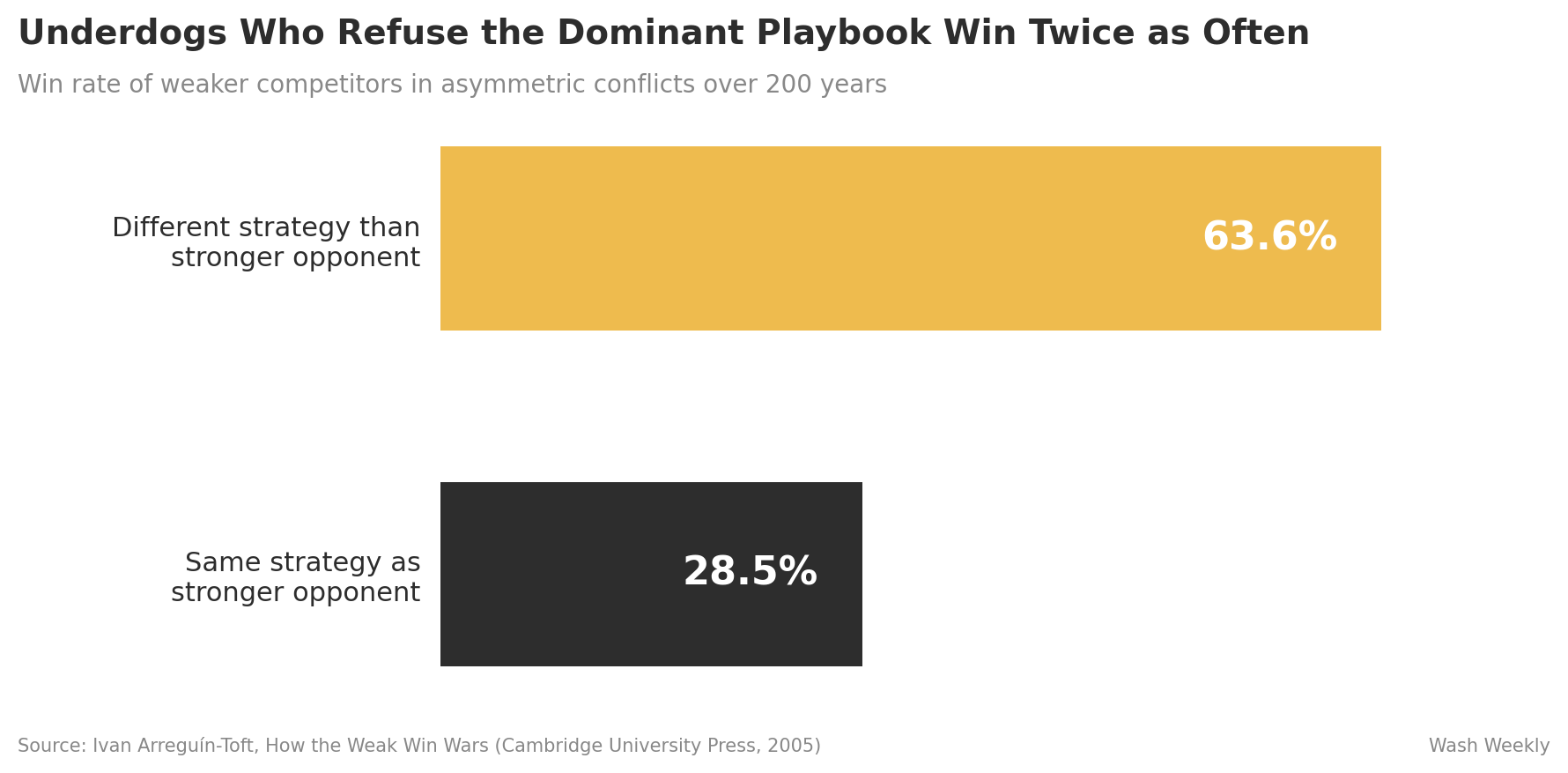
Political scientist Ivan Arreguín-Toft studied every war fought over the past 200 years between strong and weak opponents. Conflicts where one side held at least a tenfold advantage in armed might and population. He published his findings in How the Weak Win Wars.2
When both sides used the same strategy, the stronger side won 78% of the time. No surprise. More resources, same approach, predictable outcome.
But when the weaker side used a different approach, when they refused to fight on the stronger side's terms, the weaker side's win rate jumped from 28.5% to 63.6%.
That's not a marginal improvement. That's a structural inversion. The underdog goes from losing three out of four to winning nearly two out of three, simply by changing the basis of competition.
Arreguín-Toft also found