

Laundromats around the country buy equipment through the same basic structure.
A manufacturer makes the machines. An independent distributor holds sell specific brands in a defined geography. An owner/operator chooses equipment through their distributor. Two distributors in the same market generally won't carry the same brand the territories are exclusive. If you want Continental, you go to the distributor selling Continental in your area. If you want Dexter, you go to the distributor selling Dexter in your area, and so on.
But the distributor isn't just a sales channel. In our industry, the distributor is often the first call when you're evaluating a location, the person who walks your site before you commit, the one who proposes your layout, advises on equipment sizing and mix, and picks up the phone when a machine goes down six months later. I've had both experiences. One distributor proposed layouts, visited the site, evaluated the location before I committed, stayed engaged through construction, and checked in after installation. Another treated the relationship as transactional. The sale happened, equipment went in, follow-up disappeared. The territory model gives that second approach structural permission. The operator's options for that brand in that geography are limited to one distributor.
For decades, this architecture has been background infrastructure. You didn't think about it the same way you didn't think about the power grid. It was just there.
Here's what got me thinking, it isn't just there anymore.
The Numbers Behind the Rebuild
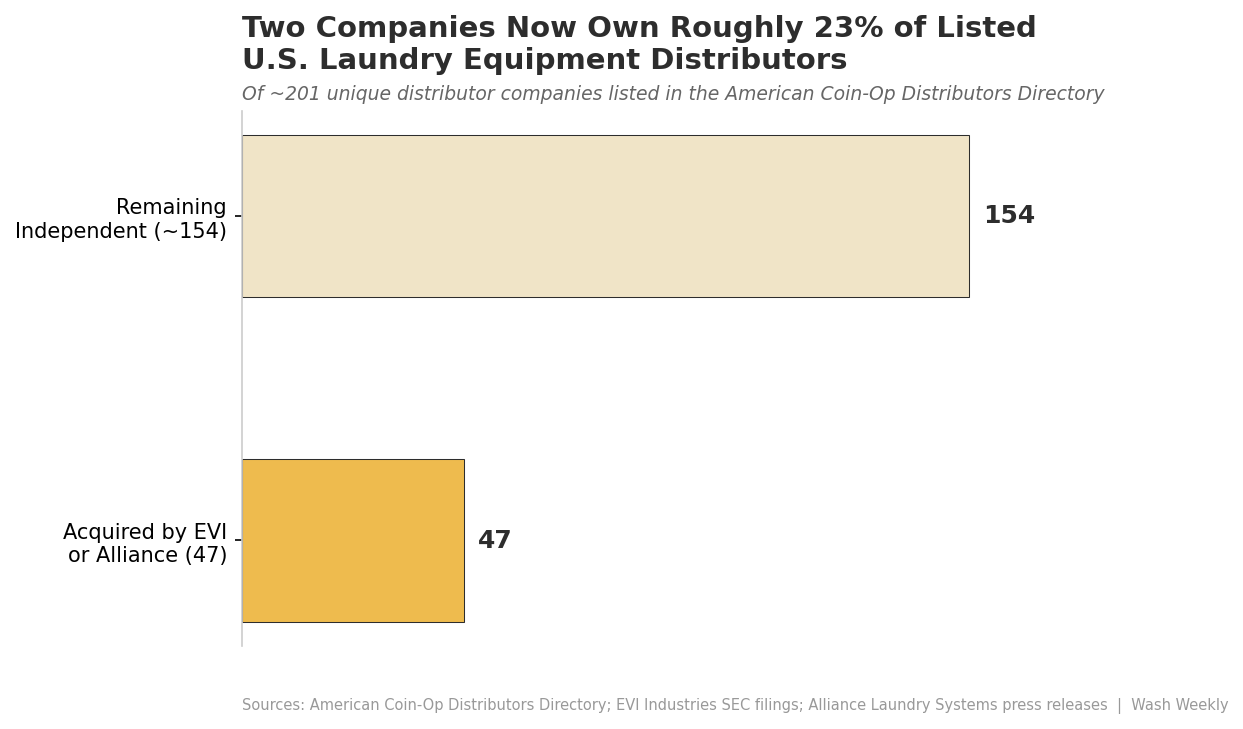
According to the American Coin-Op Distributors Directory, there are approximately 201 equipment distributor companies operating in the United States.¹ No comprehensive public registry of laundry equipment distributors exists that directory represents the most complete publicly available count, and the actual number may be higher or lower. But 201 is the best denominator we have.
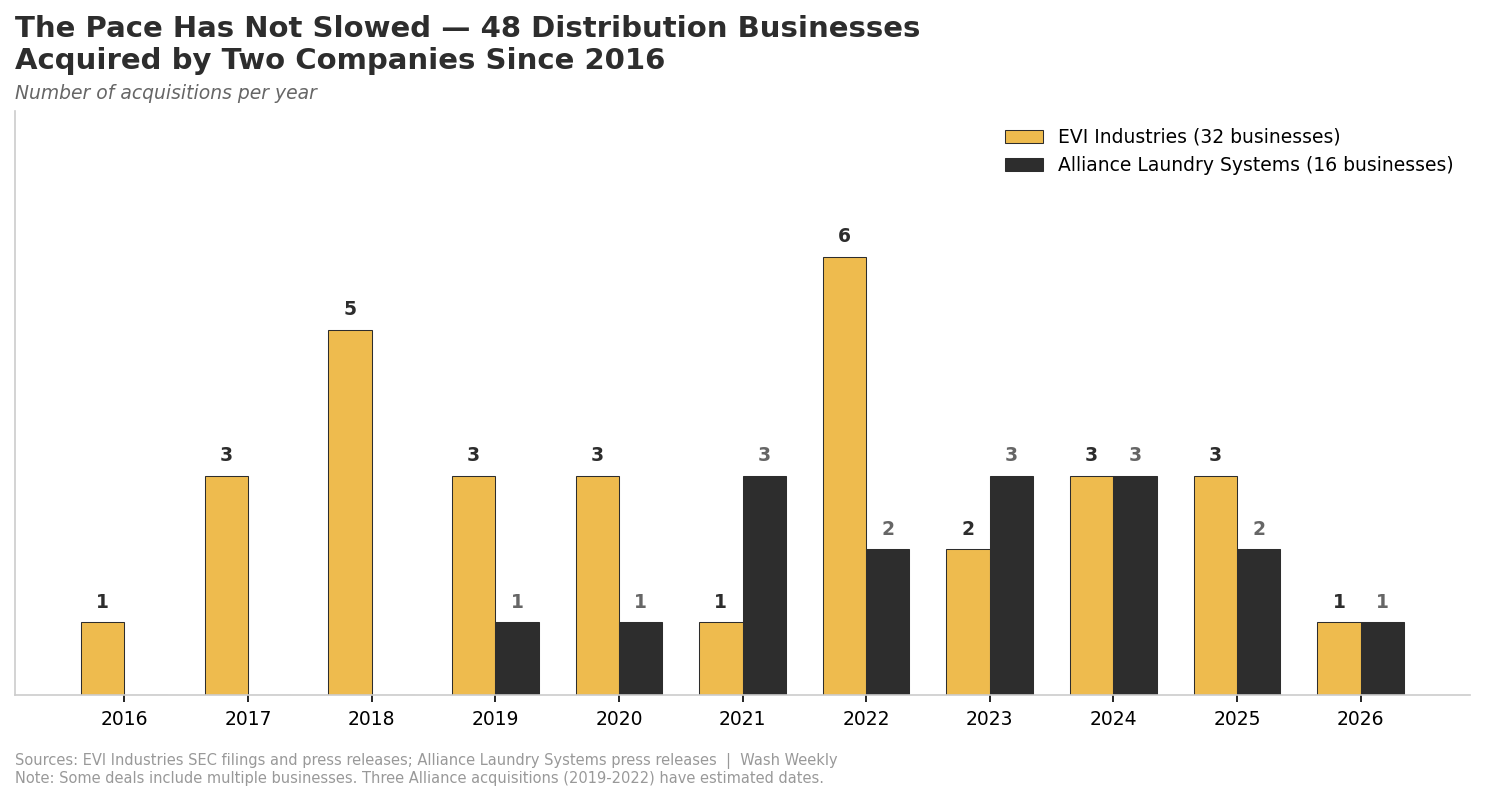
Two publicly traded companies, EVI Industries and Alliance Laundry Systems, have acquired a combined 48 of those distribution businesses in under a decade. Of those 48, 47 are equipment distributors and one is a marketing agency.
That's roughly 23% of the listed distribution layer, consolidated under two entities.
EVI Industries (NYSE American: EVI) started as a distributor. The company was founded in 1959 as Steiner-Atlantic Corp, went public in 1998, and was later renamed EnviroStar. In 2015, it pivoted to a buy-and-build acquisition strategy under new leadership.² Since 2016, EVI has completed 32 business acquisitions, 31 equipment distributors and one marketing agency.³ Revenue grew from approximately $36 million in fiscal year 2016 to $389.8 million in fiscal year 2025.⁴ The company now employs over 900 people, including more than 425 service personnel.
Alliance Laundry Systems (NYSE: ALH) started as a manufacturer. Alliance makes Speed Queen, UniMac, Huebsch, Primus, and IPSO. Five of the most recognized brands in commercial laundry. The company IPO'd on the NYSE in October 2025 and reported $1.7 billion in net revenue for full year 2025, up 13% from the prior year.⁵ Beginning in 2019, Alliance started acquiring its own distributors. By October 2024, the company described its acquisition of Bestway Laundry Solutions as its "13th in five years."⁶ Three more have followed since, Metropolitan Laundry Machinery Sales, Taylor Houseman, and Super Laundry, bringing the total to 16.
One started as a distributor buying fellow distributors. The other started as a manufacturer buying its own distribution channel. Different starting positions. Same structural outcome, fewer independent decision-makers between the machine and the owner/operator.
The Name on the Door Stayed the Same. The Structure Behind It Didn't.
The two companies operate differently after an acquisition, and the difference matters for owner/operators.