


The Vended Laundry Experience at AT&T Stadium: real insights, connections, and networking for laundry owners, operators, and investors, plus exclusive VIP stadium tours and a Dallas Cowboys Cheerleaders Meet & Greet.
Register today!
There's a corner I drive past most weeks. For about 2 and a half years, the commercial space that housed a laundromat in it sat empty.
I knew the owner and he ran it himself. In the store a good part of the time, with a few team members around him. The space was maintained, clean, equipment working, nothing about it saying neglect. He'd been there long enough that his machines were most likely paid off.
He closed after awhile, the numbers weren't there.
A little while back I drove past and there was a grand opening sign in the window. New machines, renovated space, new owners, staff on the floor.
Same corner, still no parking, still another laundromat 2 blocks away that's been there longer than either of them.
I don't know how they financed it and I don't know what they paid. What I do know is that a location that couldn't satisfactory carry an owner/operator with almost no debt is now carrying a lot of it.
That got me wondering what we actually know about how deals like that turn out.
The question I left sitting there in August
Three weeks ago I wrote about selection bias, and somewhere in the middle of working through Abraham Wald and the bombers that came back, I typed a question and kept going.⁵ Where is the data on all the failed laundromats?
I meant it as an aside. It stayed with me anyway.
That question has a plain answer. In most markets somebody is counting. Housing has default and foreclosure rates. Restaurants have closure data. Public companies file every quarter whether the quarter went well or not. Our industry has nothing like that, and it isn't because anyone decided we shouldn't. Nothing here was ever built to record a store going dark. A laundromat closes and the people who know are the owner/operator, the landlord, the note holder, and the clients who show up to a locked door.
So when we talk about whether now is a good time to buy, we do it with the successes in plain view and the failures nowhere in the frame.
What I wanted to know was whether any of it gets written down somewhere else, by somebody who isn't thinking about laundry at all.
8,042 loans, each one with an ending attached
The Small Business Administration publishes every loan it backs, and has since 1991. Each record carries the borrower, the amount, the industry code, and whether the loan was paid off or written off and it updates every quarter.
Filter it to our industry code and 8,042 laundromat loans come back, running from 1991 through June of this year, worth about $2.9 billion.¹
I pulled it and ran the numbers.
One thing to note while reading them. This is the financed slice of our industry, not all of it. Cash buyers, seller financing, conventional bank paper and the equipment finance companies don’t show up here. That leaves those deals out, and what's left is still 8,042 real laundromat purchases with a documented outcome attached to each one, which is more than exists anywhere else I've found.
Two exclusions shaped every number that follows, and they're worth saying plainly. A loan that got approved but never funded is out, because no money was ever at risk. A loan that's still running is out, because it hasn't had its chance to fail or succeed yet. What's left is the loans that finished, one way or the other, paid off or written off.
Of the laundromat loans approved in 2006 that have since finished, 35.1% were written off. For the ones approved in 2007, 36.7% were written off.
Take 2005 through 2007 and 1,110 of those laundromat loans have finished. 339 of them were written off. That's 30.5% of the group, and $50.4 million that the lenders didn't get back.
Then the picture changes. Take the whole of the 2010s and 1,467 laundromat loans have finished, with 68 of them written off. That's 4.6% of the group, against 30.5% for 2005 through 2007. No single year in the 2010s went above 9.8%, and the best of them, 2015, came in at 1.8%.
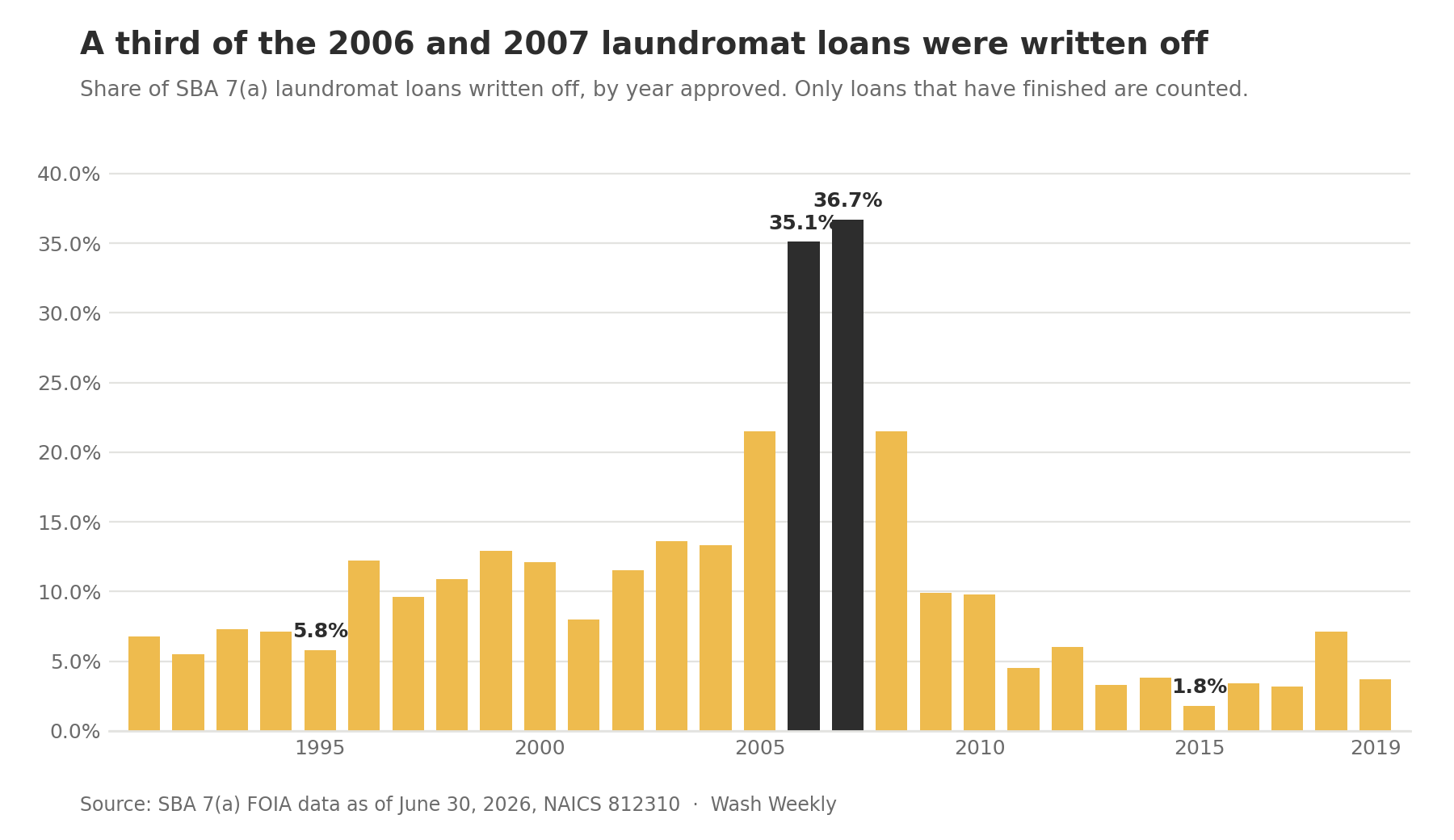
Worth being precise about what a write-off is and isn't. It means the lender took a loss. It doesn't mean the store went dark. A laundromat can change hands after a bank writes off its paper and keep running for years, and a store can close with every payment made on time.
That spike wasn't about us
The obvious read on 2006 and 2007 is that something went wrong in our industry. It didn't.
The SBA lends to every kind of small business, so I ran the same calculation across all of it. Through the 2000s, 604,573 loans of every type finished, and 144,351 of them were written off. That's 23.9% of everything the program backed in that decade, from restaurants to machine shops to daycares.
Our laundromat loans over the same 10 years were written off at 19.9%.
The 1990s say the same thing. Across every industry the SBA lent to, 11.4% of what finished was written off. For laundromats it was 9.3%.
So the write-off rate on everything the program touched roughly doubled between those two decades, and ours doubled along with it. Both times we came in under the average. Car wash loans are the fairest comparison, because there are 2,906 of them finished over that decade against our 2,880. They were written off at 22.9%. We came in under them too.
That's worth knowing the next time somebody tells you this business holds up when the economy doesn't. On the lending record, it does, and it has for 35 years. The number our industry usually reaches for is a success rate in the mid 90s, which comes from one manufacturer's own lending book rather than from anything here.² What's sitting in the SBA file is a different measure entirely, it's public.
Fewer of us are borrowing much more
Between 2005 and 2007, an average of 427 laundromat loans a year were approved, and the median one was written for $125,000.
Between 2021 and 2023, that was down to 166 a year, and the median one was written for $441,500.
Adjust for inflation and $125,000 in 2006 is roughly $180,000 in today's money.³ So the median laundromat loan hasn't tripled. It's about two and a half times bigger in real terms.
The total surprised me. Measured in real money, our industry is borrowing slightly less per year now than it was in 2006, about 9% less. Roughly the same pool of money, spread across 61% fewer loans.
Bigger loans aren't automatically worse loans, and the file can't tell the difference. A larger number can mean a bigger store, real estate folded into the deal, or a retool that pays for itself over several years. The record shows the amount, not the wisdom.
What it does mean is that if you signed for a laundromat in the last few years, you're carrying more of the industry's debt on your own than an owner/operator in your position was 20 years ago.
The resale market points the same direction. The median laundromat sale price on BizBuySell went from $220,000 in 2021 to $287,000 in 2025, while over nearly the same stretch the median owner earnings on those sales went from $90,000 to $77,104.⁴
The number that takes 5 years to arrive
The rate wasn't the part that stopped me. What stopped me was how long a laundromat loan takes to fail.
The median is 5 years. At 2 years in, only 5.4% of the write-offs that group will eventually produce have happened. At 3 years, 19.1%. At 5 years, 49.4%.
Which means half the damage from any group of laundromat loans arrives after year 5.
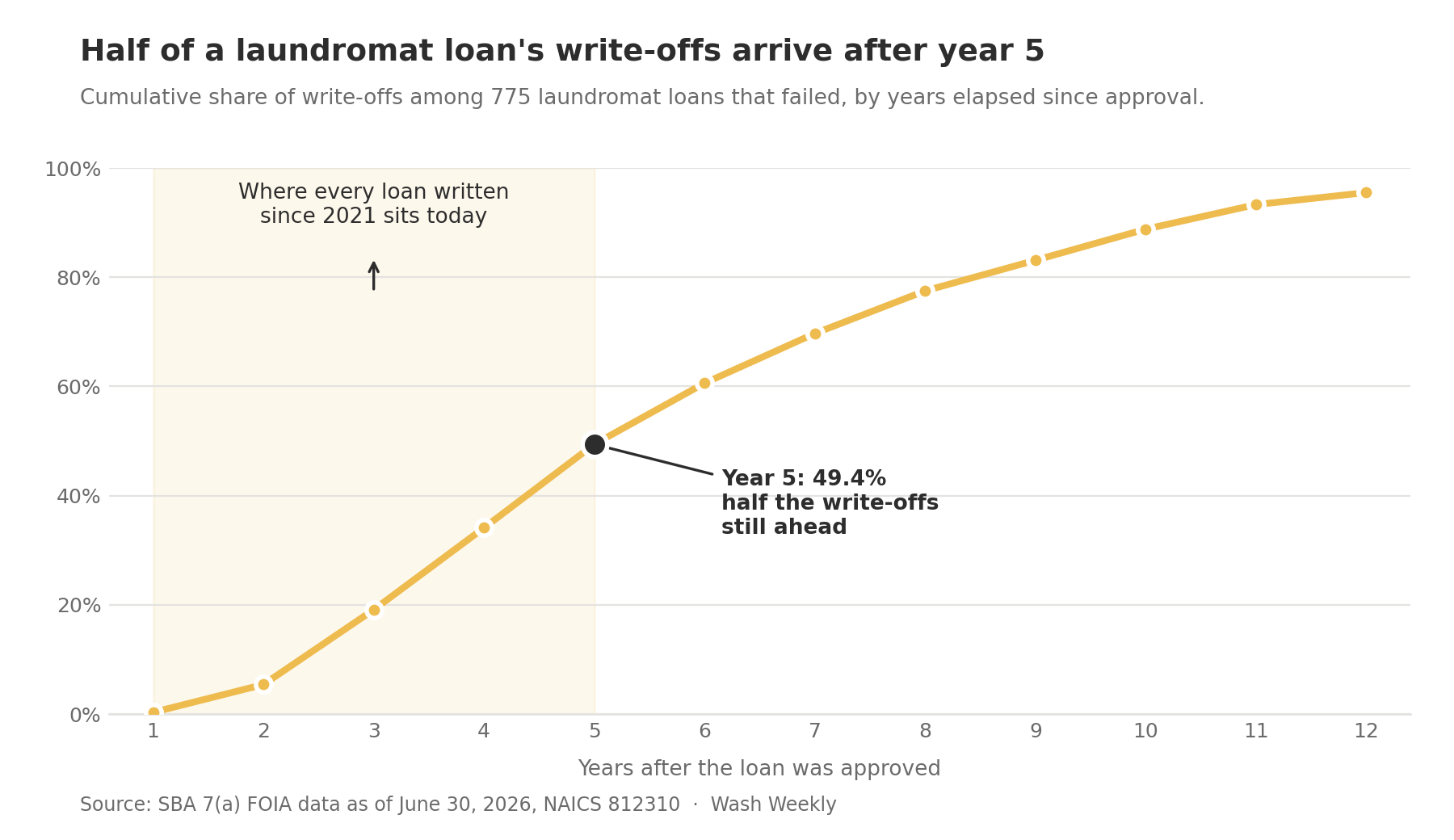
Now put the current book next to that. Between 2021 and this June, 994 laundromat loans were approved, worth $761.9 million. 715 of them are still running and hold $564.4 million, which is almost 74% of everything approved in those years.
The largest loans we have ever written are sitting between 1 and 5 years old right now. If they behave like every group before them, half of whatever they're going to do hasn't happened.
I ran the rate on them anyway, because I wanted to know. Taking just the 2021 through 2023 approvals, it comes back at 4.6%, and my first reaction was relief.
Then I looked at what the 4.6% is made of. It's 6 write-offs out of 130 loans that have finished, while another 302 from those same years are still running and 66 never drew a dollar. It's a rate built from the loans that finished early, which are the least representative loans in the group.
I had to sit with the fact that I felt something about a number before I checked what was inside it. That's the same move I wrote about three weeks ago.
So if a low single-digit rate turns up somewhere this year as proof the current book is healthy, it isn't. If it turns up as proof of trouble, it isn't that either.
Which leaves a question I can't answer, and right now neither can anyone else, that I know of.
A laundromat loan takes 5 years to fail. Three quarters of the money approved since 2021 hasn't finished. What would we need to be watching, and who would be watching it?
The answer already has a place where it shows up
The file updates every quarter.
Whatever that store on my corner does, and whatever the group of loans it belongs to does, it lands there before anyone announces it. It shows up in a spreadsheet on a government website months before it shows up in a conversation at a trade show.
I don't know how that store does. I hope it does well. The people who bought it are doing what most of us did at some point, which is putting real money behind a business we believe in.
What I do know is that the answer to how their group turns out is already being written, quarterly, in public, by people who aren't thinking about laundry at all.
Which leaves you with a question about your own store. If the years you borrowed in turn out to be a bad group, where would you find that out, and how long would it take to reach you?
Thinking about the thinking of laundry:
When you realize the number that could tell you about current laundromat success, takes 5 years to arrive. You wonder how much has just been a guess.
That's all I got for you today.
Waleed
Echoing the thoughts of Hyman Minsky.
Stability is destabilizing.
FOOTNOTES
¹ U.S. Small Business Administration, 7(a) and 504 FOIA loan data, files as of June 30, 2026. Figures for NAICS 812310, Coin-Operated Laundries and Drycleaners, computed by Wash Weekly from the loan-level records.
² Speed Queen, laundromat investment page. The stated rate is drawn from Speed Queen Financial Services' own loan originations. Examined in more detail in Why Isn't Every Laundromat Successful?
⁴ BizBuySell laundromat valuation benchmarks, based on 855 sold listings, 2021 to 2025. Sale prices and owner earnings are medians. The multiple published alongside them is an average of individual deal multiples and is not used here.
⁵ Wash Weekly, Is Our Industry Built on Data or on Selection Bias? (August 9, 2026).


