


The Vended Laundry Experience at AT&T Stadium: real insights, connections, and networking for laundry owners, operators, and investors, plus exclusive VIP stadium tours and a Dallas Cowboys Cheerleaders Meet & Greet.
Register today!
A U.S. Navy personnel specialist in Chula Vista went public a few weeks ago with what she's earning with her side gig. Somewhere between $8,000 and $11,000 a month, doing other people's laundry from her house, on the Poplin app.¹
The piece ran in Entrepreneur, then IBTimes UK picked it up. Similar features followed across national business media through spring and summer of 2026, including a Woman's World feature that gave a reality check on the platform-advertised earnings.³ Axios Richmond ran another in August, reporting that Poplin now operates in more than 500 cities, that nearly 600 laundry pros are working the platform in metro Richmond alone, and that 3,200 local clients have moved 1.2 million pounds of laundry through it since the platform launched there in 2020.²
These media features are the surface of this. What they don't map is the mechanism these stories are producing underneath. Four different businesses now share one name in our industry, and the segment with the least fixed cost to defend is the one influencing the markets price the rest of us have to defend against.
Four businesses share one name
The words "wash and fold" cover four supply side segments in our industry right now, and the four run on structurally different economics.
The first is the laundromat that offers wash-and-fold as an ancillary service, carrying rent, machines, utilities, staffed hours, insurance, and the P&L pressure that comes with all of it. The second is the dedicated wash-and-fold or PUD-only facility, purpose-built, still fixed-overhead, but stripped of the self-service business the first segment carries alongside it. The third is the home-based independent operator, working from a residence, with partial overhead and no dedicated rent line item. The fourth is the gig-app laundry pro, working through Poplin, SudShare, HamperApp, or other apps, using their home washer and dryer or local laundromat, paying no rent for the space the machines sit in, and treating the work as a side hustle they can turn on and off.
All four are called wash and fold in client conversations, in Google search, in our own industry writing, and in the national business media features running right now.
When one word covers four cost structures, price benchmarks flow across the vocabulary. The client comparing options doesn't see four different businesses. They see one service with a price range attached to it. And they latch on to whichever number they saw first or is more appealing to them.
The outside washer bag on our floor
A client walked into our store a while back with a stack of laundry bags over flowing the bin, not one or two but five, each with a different name tag. She loaded them into our larger washers back to back, ran them through, folded them at our tables, and left.
She would fall into segment 4. She was using our self-service machines to process orders for her own clients, because our capacity was faster and cheaper for her than doing five loads at home in sequence would have been.
That's the moment the piece I'm writing today started forming in my head. I didn't feel threatened by what I saw. I noticed something I hadn't seen named anywhere in the trade press, blogs or newsletters. The client I'd been thinking of as competition through her platform work was, at the same moment, a paying self-service client of ours. The same architecture that puts her in the same category as our WNF service also puts her in our machines as a paying self-service user. The threat and the demand are the same person.
Blue oceans turn red for a reason
W. Chan Kim and Renée Mauborgne named a distinction in the Harvard Business Review in October 2004 that shows up in every strategy book on every business school syllabus since. They called it blue ocean strategy.⁴
Red oceans are existing market spaces with defined boundaries, accepted competitive rules, and known buyers. Companies inside them fight for share of a demand pool everyone can see. As the space crowds, prospects for growth compress, products commoditize, and competition turns bloody. Hence the color red. Blue oceans are the opposite, offering uncontested market space, demand created rather than fought over, and opportunity for growth that carries pricing latitude and no direct comparison. Kim and Mauborgne argued that the sustainable move is not to compete harder in a red ocean but to make the water color change.
WNF in our industry was closer to a blue ocean for many owner/operators in the late 2010s. The client base for pickup and delivery was small, the vocabulary was still being built, and the owner/operators who moved first got pricing latitude and market education paid for by their own marketing. It's not blue anymore. What turned the water was the four-segment architecture. Every time a new segment adopts the same category name, the water gets darker and darker.
What our own survey is already saying
The CLA published the 29th annual laundry industry survey earlier this year. Readex Research out of Stillwater, Minnesota, worked with 269 usable respondents at a margin of error of plus or minus 5.8 percentage points at 95% confidence. The numbers inside it are the most rigorous industry level look at what's happening right now.⁵
In the next 12 months, 8% of respondents plan to build a new WNF or PUD only facility. 6% plan to purchase one and 1% plan to sell one. That is a build-versus-sell ratio of roughly 14 to 1 for dedicated facilities in the segment we've been calling ancillary. The dedicated segment is expanding. And it's expanding faster than industry conversation has named.
55% of respondents offer drop off WNF and 29% offer PUD directly. 29% of CLA-affiliated laundromats are already competing on the same client pond that Poplin, SudShare, HamperApp, and others fish in.
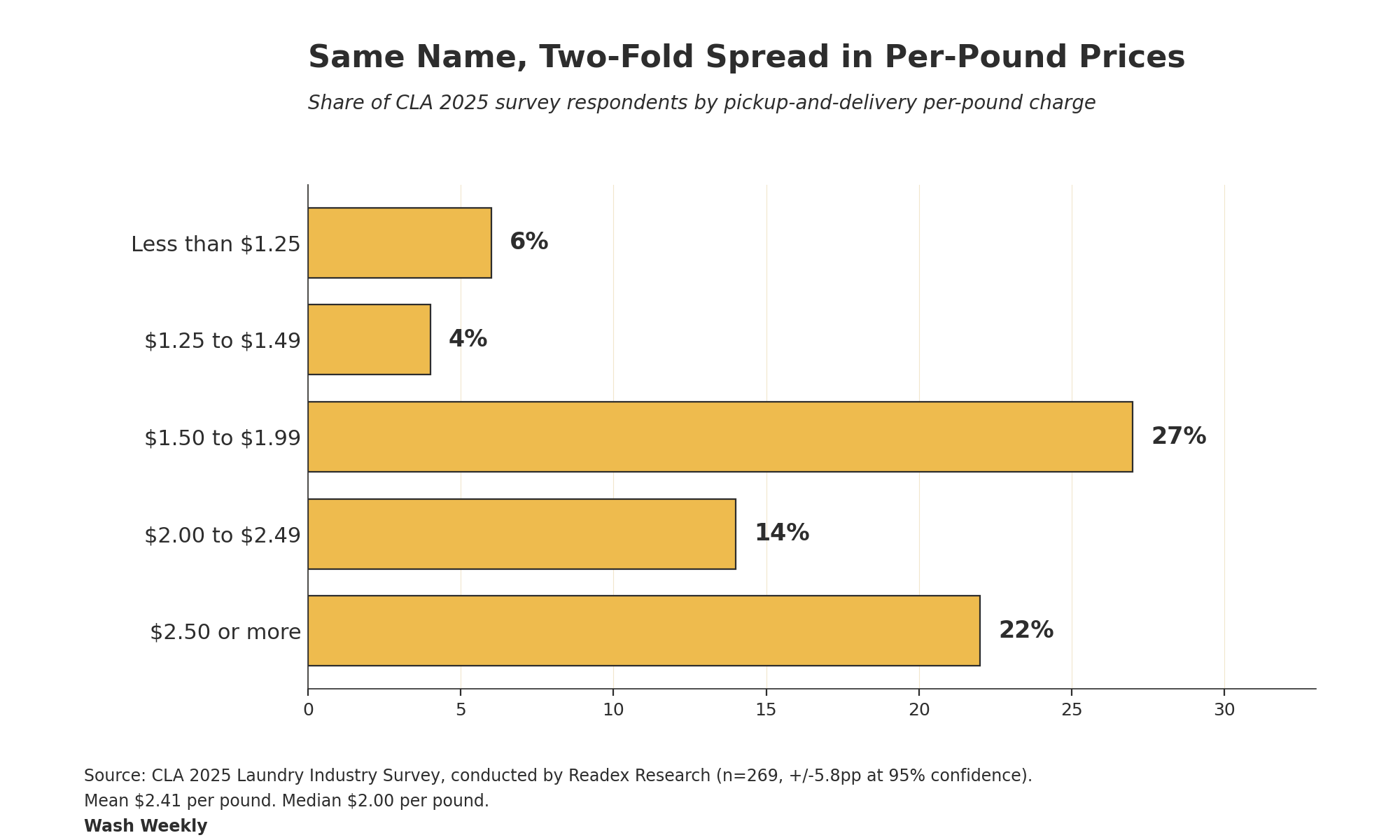
The pricing spread inside the CLA respondent pool tells the mechanism plainly. Per pound PUD pricing runs from less than $1.25 (6% of respondents) up to $2.50 and over price point (22% of respondents). The mean is $2.41 and the median is $2.00. That's a roughly two fold spread inside one well defined pool, all of it called WNF. Poplin's own work from home page says the average laundry pro earns about $40 per order at a $22.50 minimum, plus tips.⁶ Poplin prices by the order, not by the pound. But that's the reference frame the client is comparing our per pound WNF pricing against.
And this is what a two-fold spread looks like on the P&L. Median operating net profit as a share of gross revenue went from 27% (2023) to 22% (2024), roughly 500 basis points off the median in one year. Median gross revenue went from $335,000 to $323,000 in the same window. Median rent among respondents renting their space came in at $3,980 per month. That's the fixed overhead the segment 1 owner/operator is defending. The gig app launderer's rent for the space their machines sit in is her mortgage or their rent, and it's not a line item on the laundry side of their budget.
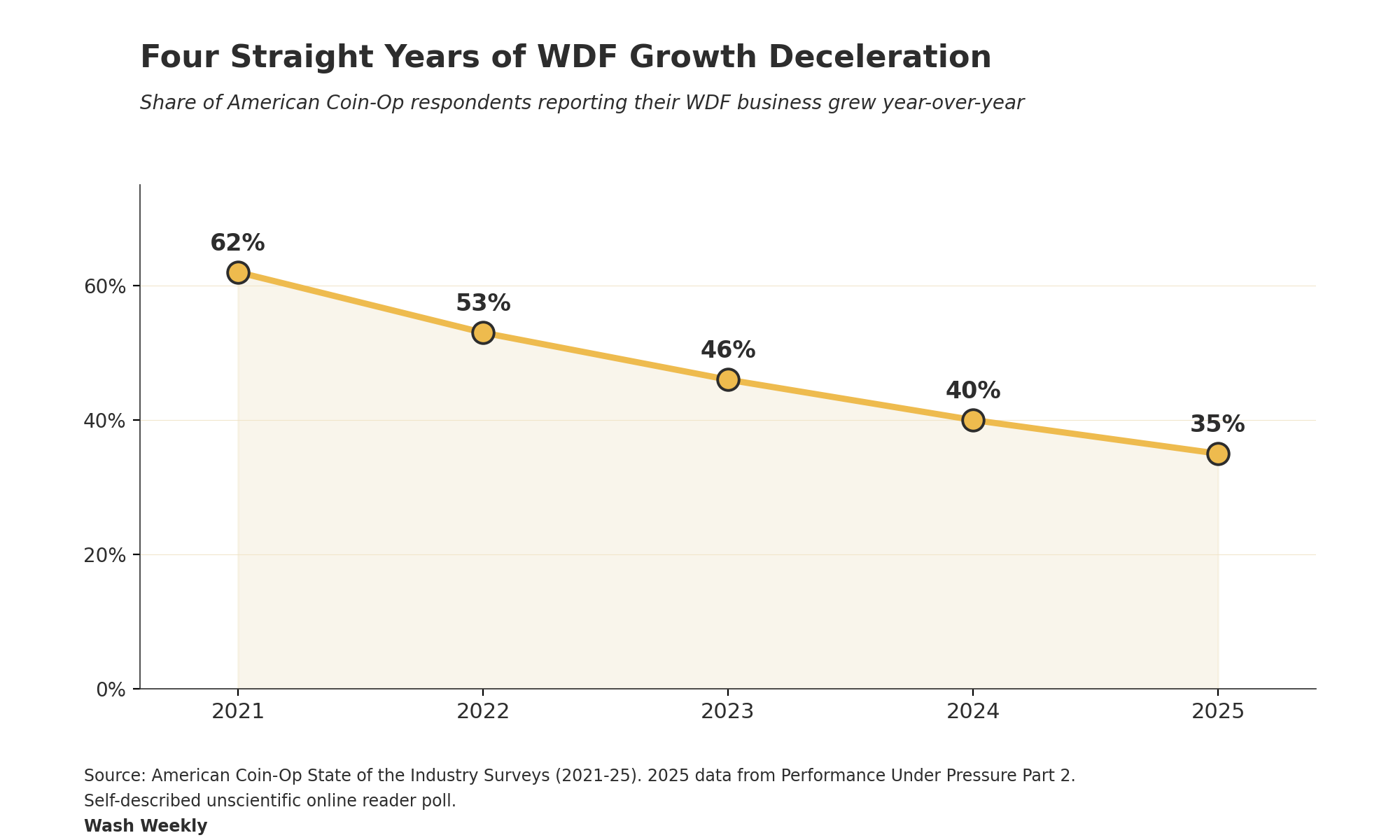
American Coin-Op's State of the Industry survey tells a smaller but consistent version of the story, in a reader pool they themselves describe as unscientific. The share of respondents reporting their WNF business grew year over year has gone 62% (2021), 53% (2022), 46% (2023), 40% (2024), 35% (2025), four straight years of deceleration.⁷
Where the mechanism has run before
This same mechanism has run in three adjacent industries in the last decade, and each one produced measurable earnings compression on the incumbent players.
Ride-share. Berger, Chen, and Frey, published in the European Economic Review in 2018, estimated that Uber's entry into a new market produced about a 10% relative earnings decline for incumbent taxi drivers on average. San Francisco taxi trips fell 65% between 2012 and 2014.⁸
Food delivery. The UC Berkeley Labor Center reported in 2024 that typical gig passenger and delivery drivers earned less than the applicable minimum wage in all five metros studied.⁹
Airbnb hosting. Zervas, Proserpio, and Byers estimated that in Austin, where Airbnb supply is highest, Airbnb's entry produced a hotel revenue impact of 8 to 10 percent.¹⁰
The pattern in each case reads the same. National business media amplifies the entry story, low barrier entrants flood in, and vocabulary parity with the incumbent segment forms fast. Price benchmarks then flow across the shared category, incumbent margins compress, and the segment specialists survive while the generalist side hustlers exit.
The question no denominator can answer
The contradiction is sitting in plain view. Our industry conversation still names WNF as the growth answer for the laundromat owner/operator. The CLA 2025 survey shows median operating net profit down 500 basis points in one year, median gross revenue down, and 8% of respondents planning to move out of the traditional laundromat plus WNF model into dedicated PUD only facilities. The vocabulary and the numbers are pointing in different directions.
The absence sitting alongside the contradiction is louder. Nobody publishes a total count of active WNF or PUD providers across the four segments. There is no denominator. Which means there is no way, from any publicly available source, to answer the one question the mechanism is asking.
Every actor in the ignition chain benefits from the absence. Platforms want more supply, so they recruit without publishing saturation data. National business media runs the side hustle features because they perform, and a piece on the earnings mechanism 24 months out doesn't. Courses and coaches sell entry, not exit analysis. The single actor whose interest would be served by a real denominator is the owner/operator considering the entry, or already in the segment, and the owner/operator is the one without the data.
Which brings me to the question the mechanism is asking us right now.
When the market reference price for WNF is set by someone who doesn't pay rent, what does an owner/operator with fixed and variable overhead do?
Thinking about the thinking of laundry:
When you realize the going rate for wash and fold is being set by someone whose only overhead is a bottle of Tide.
Which brings me back to the client with the five laundry bags.
Some owner/operators are treating the segment 4 launderer as a competitor. Some are quietly treating them as a client, not on the WNF side of the ledger but on the machine time side. The gig app pro who runs her platform orders through a well run self-service store is a paying self-service client for as long as our machines are faster and cheaper than doing the work at home. That doesn't remove the pricing pressure the four segment architecture is putting on our drop off line. It does mean the same architecture creating the pressure is also producing a demand source most owner/operators haven't sat with yet. Threat and demand arrive in the same person, walking through the same door.
I'm not telling you which posture to take. I'm telling you both postures are available inside the same mechanism, and the mechanism doesn't care which one you pick.
Where this leaves us
The four segments will keep sharing one name. The market reference price will keep drifting toward whoever carries the fewest of the fixed costs. The play available to any given owner/operator depends on which of the four segments the store is actually built to compete inside, and whether the game being played is visible from where the owner/operator is standing. Our industry has run this same mechanism through PUD pricing since about 2018, and we've been calling it something else the whole time.
The word WNF used to name one business in our industry. It names four now and the pricing is following the vocabulary, not the cost structure. That's the mechanism. Where it goes next depends on us.
That's all I got for you today.
Waleed
Echoing the thoughts of W. Chan Kim.
The best way to beat the competition is to stop trying to beat the competition.
FOOTNOTES
¹ Entrepreneur, I'm in the Navy and Have a Side Hustle Making $8,000 to $11,000 a Month, published August 27, 2026. First-person account by Monalisa Escobedo, personnel specialist in the U.S. Navy, on her Poplin side hustle in Chula Vista, California. Picked up shortly after by IBTimes UK, US Navy Mum Makes Up to $11,000 a Month Doing Other People's Laundry From Home.
² Axios Richmond, Richmonders make extra cash doing laundry with Poplin, August 14, 2026. Poplin operating figures attributed to company spokesperson Pete Bahrenburg, including 500-plus U.S. cities, 600 laundry pros in metro Richmond, and 3,200 customers moving 1.2 million pounds since the platform launched in the market in 2020.
³ Woman's World / Yahoo Finance, These Apps Turn Laundry & Errands Into Real Money — Here's How, March 2026. Analysis and reality check on advertised platform earnings by work-from-home expert Holly Reisem Hanna.
⁴ W. Chan Kim and Renée Mauborgne, Blue Ocean Strategy, Harvard Business Review, October 2004. Expanded in Kim and Mauborgne, Blue Ocean Strategy: How to Create Uncontested Market Space and Make the Competition Irrelevant, Harvard Business School Press, 2005.
⁵ Coin Laundry Association, 2025 CLA Laundry Industry Survey, conducted by Readex Research, Stillwater, Minnesota. Survey closed for tabulation May 29, 2025 with 272 usable responses (5% response rate); 269 respondents used for main findings. Margin of error ±5.8 percentage points at 95% confidence. Raw survey data available to CLA members via membership@laundryassociation.org.
⁶ Poplin, Work-from-Home page, accessed September 2026. Company reports an average earned per order of about $40, a minimum per order of $22.50 plus tips, and top laundry pros earning over $6,500 per month.
⁷ American Coin-Op, Performance Under Pressure: Operators Post Another Strong Year (Part 2), 2025-26 State of the Industry Survey. Described by the publication as an unscientific online poll of American Coin-Op readers who operate stores. Historical WDF growth reporting series compiled from consecutive annual surveys reporting the same measurement basis (share of respondents whose WDF gross dollar volume, drop-off plus PUD combined, increased year-over-year).
⁸ Thor Berger, Chinchih Chen, and Carl Benedikt Frey, Drivers of Disruption? Estimating the Uber Effect, European Economic Review, vol. 110, 2018, pp. 197-210. Study of Uber's staggered rollout across U.S. metropolitan statistical areas, drawing on American Community Survey samples. San Francisco taxi trip decline of 65% between March 2012 and July 2014 from the San Francisco Municipal Transportation Agency, per Kate Toran, Interim Director of Taxis and Accessible Services, presented to the SFMTA Board of Directors in September 2014 and reported widely; see KQED News, "Uber, Lyft Fallout: Taxi Rides Plunge in San Francisco".
⁹ UC Berkeley Labor Center, Gig Passenger and Delivery Driver Pay in Five Metro Areas, 2024.
¹⁰ Georgios Zervas, Davide Proserpio, and John W. Byers, The Rise of the Sharing Economy: Estimating the Impact of Airbnb on the Hotel Industry, Journal of Marketing Research, 54(5), 2017, pp. 687-705.


