


PUD Intensive ... Jan 22, 2027, Charlotte, NC
Thinking about adding pickup and delivery to your Laundromat? Spend a day inside The WashRoom Laundry Service while it's running. Saichelle McNeill walks you through pricing, route math and where PUD customers come from. You leave with a written 6-month plan for YOUR business, not a notebook full of "aha moments" you'll never open again. 4 seats, $895, lunch included. Text (704) 734.7100 to hold one.
There's this stretch of time, right after you bring new technology into your laundry business, when everything feels possible. You've been shown what it's going to do for your business. The company has called you every couple of weeks to walk you through it. You sign, you launch, and the first glitches barely bother you, because their team jumps on them fast.
You tell them what broke. Then you tell them what would make it better. They're glad to hear it, and they have more calls, more ideas, and more of what you and your team are seeing on the floor.
For me, that stretch came with a POS provider. At one point there were about 10 people from the company on a call with me, from different levels of the business, and I was the only owner/operator on. They came to hear what I had to say.
That much attention tells you something valuable is being exchanged. It took me a while to ask what it was, and who ended up with more of it.
The knowledge a vendor can't produce on its own
Eric von Hippel at MIT spent decades studying where product improvements come from. One of his central findings is that the people who use a product hold detailed knowledge of what they need, and that knowledge is "sticky," meaning it's costly to move from where it lives to anyone else.¹
A software company can hire engineers, designers, and support staff. What it can't hire is the experience of running a laundromat every day. That knowledge sits with us, and the vendor's calls, user groups, and feature request boards exist to move it from our stores onto their roadmap.
In that moment, we're doing the work consultants do. Firms like McKinsey and Bain bill their clients to diagnose operations, find what's broken, and recommend what to build. On a vendor call, the owner/operator does the diagnosing, the vendor receives the recommendations, and the owner/operator is the one paying a monthly fee.
When a vendor builds a feature from an idea we gave them, they build it once and ship it to every laundry business on the platform. That includes the owner/operator down the street from you and I running the same system.
The feature still helps our store, but it stops being our edge and becomes the baseline every laundry business on that platform starts from. The more of our competitors who run the same system, the faster that happens.
I've started calling this the “unbilled hour”. It's consulting work we do for our vendors, it carries no price, and what it produces gets sold to everyone on the platform.
The call that got smaller
Some of what I shares on those weekly calls got built. Some of it was promised and didn't happen. That's normal in software, and I'd expect it from any vendor.
What I didn't expect was how the relationship changed over time. We went through at least 3 account managers. One was new to the company and new to our industry, which made it hard to build on anything we'd already covered.
The group on the weekly call got smaller. Fewer people from the company joined. Eventually it was just my account manager and me, and I was already sending that person every issue by text and email, so we stopped the calls.
Along the way, I had a long, in-depth conversation with a senior leader at the company. It ran well over an hour. He walked me through what they planned to address and said he'd send a written outline of all of it. The outline never came.
A friend of mine in laundry had a similar experience with a different POS platform. He was part of a group of owner/operators who met with the company on a regular schedule and suggested improvements. Over time the calls got thinner, and eventually, he told me, questions the group sent the company went unanswered.
There are ordinary explanations for all of this. Account managers turn over, staff get reassigned, and roadmaps change. A company can't build everything its clients ask for, and I can't speak to what drove any of it inside either company.
What I can describe is the pattern. The attention was greatest at the beginning of the relationship, when we had the most to tell them. It faded after that, while the monthly fee stayed the same.
What our industry charges for the same hour
Laundromat coaches and consultants post their rates publicly, and those rates tell us what our industry charges for operating experience.
Across 5 of them, the posted price for an hour of their time runs from about $127 to $750, and 4 of the 5 sit between $375 and $750.² While 5 posted rates aren't a survey of the whole market, they show that our industry already puts a price on this kind of knowledge.
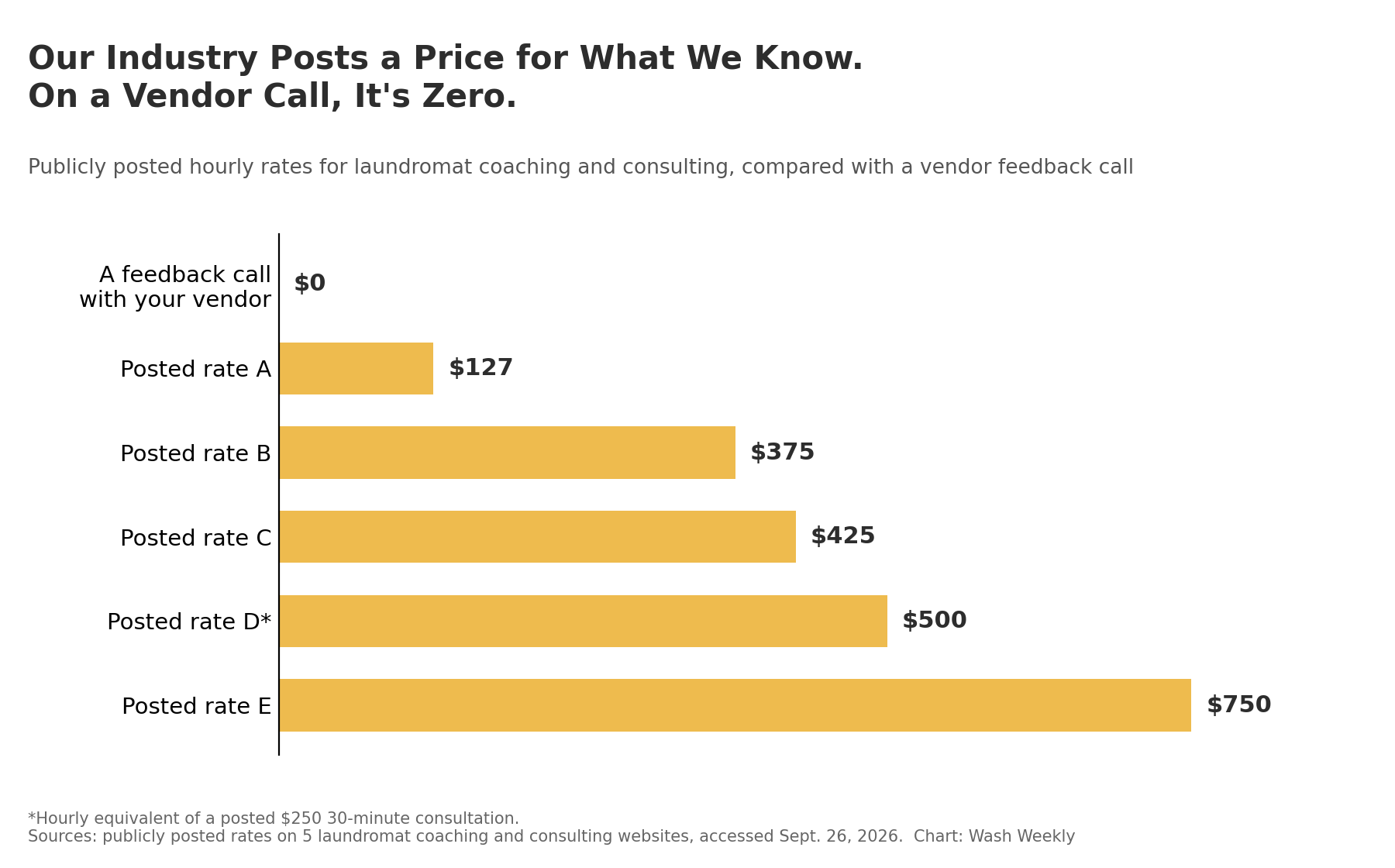
Those rates pay for the same raw material a vendor asks for on a feedback call, which is operating experience applied to a specific problem. Someone buying an hour of that experience pays up to $750. A vendor gets it at no charge, from an owner/operator who's also paying that vendor every month.
Research on how companies collect ideas from outside contributors suggests that price matters more than it seems. A 2013 study in Organization Science by Nikolaus Franke, Peter Keinz, and Katharina Klausberger, run with design students and a national sample of young adults, found that people deciding whether to contribute to a company's product development weigh fairness alongside their own benefit.³ Among the most skilled potential contributors, fairness mattered even more than self-interest.
The researchers also found that people who had already taken part in these programs cared far less about fairness than people who hadn't. They raised the possibility that the people who weigh fairness most heavily simply choose not to participate.
If that holds in our industry, an unpriced feedback program shapes whose knowledge a product gets built on. The owner/operators who think hardest about what their experience is worth may be the ones who stop showing up.
Von Hippel's work also explains why users so often give their improvements away. Among the reasons he gives, the person sharing an idea often stands to lose little or nothing by revealing it.¹ His evidence comes from fields like surgery, library systems, and sporting equipment. A library that shares a better catalog search loses nothing to the library across town. A laundromat that hands its idea to a shared platform hands it to the store across town too.
Every kind of contribution has a price somewhere
LEGO runs a program where fans submit ideas for new sets. When an idea goes into production, the fan designer receives 1% of the set's net sales.⁴ It's one of several ways companies outside our industry already pay for the kinds of contribution we make on a vendor call.
Medical device makers pay the physicians who use their products for consulting and for intellectual property those physicians help create. The practice is common enough that federal law requires the payments to be reported publicly, and "royalty or license" is one of the reporting categories.⁵ One study of that data found orthopedic surgeons received about $1.3 billion from industry between 2014 and 2018, most of it in royalty or license payments.⁶ Those payments are public because they can create conflicts of interest, and the device industry's own trade association describes physician expertise, feedback, and experience as critical to advances in medical technology.⁷
Google paid $17.1 million to 747 outside researchers in 2025 for finding and reporting flaws in its products, and $81.6 million since 2010.⁸
Ideas earn a royalty at LEGO, expertise earns consulting fees and royalties in medicine, and flaws earn bounties at Google. On a single vendor call, a laundry owner/operator often provides all three in the same hour.
Testing belongs in its own category. A beta program asks us to fine tune something the vendor has already designed, funded, and built. Feature ideas and feedback groups shape what gets built in the first place, and that's where our knowledge carries the most weight.
The first price tag I've seen in our industry
A disclosure before this next part. Our store is a new client of Card Concepts Inc. (CCI) at one location, and CCI's announcement of the program below hit my inbox while I was working on this piece.
CCI has launched the CCI Insider Program. It invites laundromat owners to test near release software, firmware, and select hardware in their stores, and it