


Cut your detergent costs without cutting corners. Each pod is precisely dosed, so you only pay for what every load needs and nothing goes to waste. Businesses unlock wholesale pricing that improves the more you order.
On June 22, 2023, on one of the largest business podcasts in the world, Codie Sanchez called laundromats a terrible business to buy.¹ In the same breath she explained why she talks about them. It was her first business, and it's easy to understand.
She's used the laundromat as her signature story for years, before that moment and after it.² That's what makes the statement worth thinking about. The person who did more than almost anyone to put laundromats in front of a general audience has labeled it as a bad buy.
The example that outlives the verdict
Quarter, machine, clothes clean. Her words from that episode. You can teach the whole model in 4 words, and your audience gets it before you reach the end of the sentence. A business becomes the public face of an industry for a reason that has nothing to do with whether it's a good business. It becomes the face because it's the easiest thing to explain to someone.
Once a business is the simple example, that lands with the most people easily, it keeps getting repeated. It gets told after the teller has moved on from it. It gets told after the teller has decided it isn't a good buy. The story lives on based on how well it explains, not on how well it holds up.
So our industry ends up with a reputation built out of the simplest sentence somebody could say about it, repeated mostly by people who were passing through our industry.
What the simple version leaves out
A while back someone told me about a store they were buying. An existing laundromat, up and running, older machines but working just fine with revenue coming through the door. They'd put a deposit down and gone under contract. While lining up financing, the finance company told them it wouldn't fund the purchase unless new equipment went into the store.
They were surprised. They'd bought into the idea of a cash flowing business they could step into and run. Nobody had told them the money for the deal might require them to retool a store that already worked, and carry a bigger note for the trouble.
What stuck with me was the problem sitting underneath that problem. This was their first laundromat, so they didn't yet know the real revenue of the business they were buying. You don't, not until you're the one running it. The numbers a seller hands you can be shaped a dozen different ways, and the only way to learn what a store really does is to run it for a while before you change a thing. The simple version of this business, the one that got them comfortable enough to put down a deposit, didn't inform any of that.
A number that travels because it's clean
Sanchez has said she paid about $100,000 for her first laundromat and that it cleared around $67,000 a year.³ That's a nice deal, which is roughly 1.5 times earnings. The benchmark that exists captures only sales reported on one platform, but across 855 of them the typical laundromat changes hands closer to 3.3 times earnings, near a $250,000 price, on about $77,000 of owner earnings.⁴
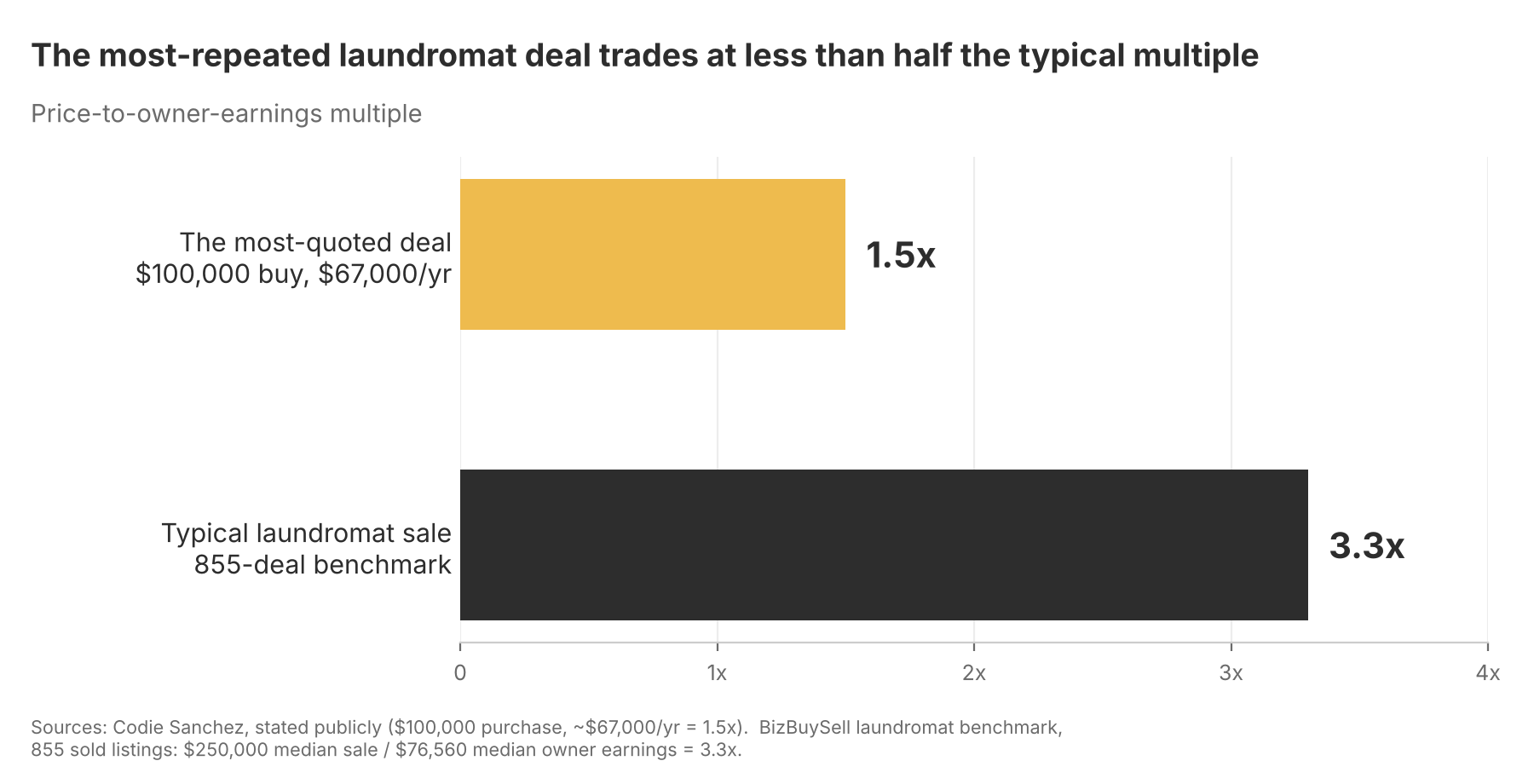
Read those side by side and the most repeated laundromat deal in the country sits well outside what a buyer is likely to find. It's an unusually good deal that gets told as if it’s a normal one. And it gets told repeatedly for the same reason the 4 word model does. It's clean, round, and easy to hold in your head, $100,000 in and $67,000 out, clean round numbers are the ones that get repeated.
She isn't where this started
It's worth being precise about her role, because it's easy to hand one person credit for the whole climate. The Wall Street Journal traces the online laundromat wave to a different creator, a laundromat owner who built a following filming the cash coming out of his store, and who now warns that people are getting trapped by videos that glamorize the work.⁵ The CLA has pushed back on the picture of a business where you show up once a week and collect quarters.⁵ Sanchez is the most visible version of the story. She isn't the source of it.
What she is, usefully for us, is the clearest case of why the simple version wins. Researchers have found that the easier something is to process, the more valuable it looks. Stocks with names that are simple to pronounce beat harder ones in the days after they list.⁶ A study of financial influencers found that most weren't skilled, and that the ones who drew the biggest followings were the most engaging, not the most accurate.⁷ Quarter, machine, clothes clean is the small business version of a name that's easy to say and remember.
One voice, one category
This isn't new, and it isn't unique to us. In 2012 the television doctor Mehmet Oz called a green coffee extract a miracle for weight loss. Two years after he was seated in front of a Senate subcommittee and conceded his language had been flowery, after his own show's clips were used to sell the product.⁸ One voice had moved an entire product category.
When the 2004 film Sideways had its lead actor refuse to drink Merlot, researchers later measured Merlot demand softening and Pinot Noir climbing in the years that followed.⁹ The part worth looking at is the twist. One of that paper's own co-authors argues the effect may never have been real, since chardonnay, a wine the film never mentions, fell just as hard as merlot.¹⁰ Even the cleanest story about one voice setting a category's reputation gets argued over once people look hard at it. The reputation forms first, the checking comes later, if at all.
The thing hiding in plain sight
Our industry's most repeated success story is a deal its own teller has set aside as a bad buy, and keeps telling because it fits in 4 words. The quality that made it travel is the same quality that makes it a poor place to learn the laundromat business from. Legible and representative aren't the same thing, and people have been handed a lot of the first while believing they were getting the second.
That leaves a question worth carrying into your own laundromat.
How much of what you believe about your own business came from someone for whom it was a stepping stone, not a life's work?
The four word version is a piece of content. The business is everything the four words leave out. It leaves out the financing call that lands after the deposit is already down, the revenue that only turns real once you're the one counting it, and the afternoon you lose to a machine that won't operate properly. None of that explains well in a sentence, which is exactly why it rarely makes the video. It's also where the work, and the edge, actually live.
Thinking about the thinking of laundry:
When you realize small businesses have become props on social media versus actual case studies.
That's all I got for you today.
Waleed
Echoing the thoughts of Daniel J. Boorstin.
The celebrity is a person who is known for his well-knownness.
FOOTNOTES
¹ The Diary of a CEO, Episode 258, June 22, 2023 — verified from the episode transcript: advising a content creator, Sanchez says of the laundromat "it's a terrible business to buy," calls it her easy-to-understand first business, and says she should start citing a different first business. "Quarter machine clothes clean" is her own phrase.
² Codie Sanchez, X, Oct 29, 2024 — verified on X: "A laundromat was my 'gateway drug' business, and it could be yours too... 7 strategies for growing a laundromat."
³ Young and Profiting, Episode 231 — verbatim: "I bought my first laundromat for a hundred K. It made me 67 K a year." Figures recur across tellings; attribute as "she has said."
⁴ BizBuySell laundromat valuation benchmark — 855 sold listings; $250,000 median sale ÷ $76,560 median owner earnings = 3.27x, rounded to 3.3x (BizBuySell separately lists a 3.65 average earnings multiple). Codie's $100,000 ÷ $67,000 = 1.49x ≈ 1.5x.
⁵ Wall Street Journal, John Keilman, "The Internet Told Them Owning a Laundromat Was Easy Money. It Was Anything But.," Oct 19, 2026 — accessed via syndication; re-pull the original before publish. Facts corroborated independently: Carlos Ochoa ("Laundromat Money," ~2M followers) and CLA CEO Brian Wallace (~$300K small laundromat, ~24% margin).
⁶ Alter & Oppenheimer, PNAS, 2006 — fluently named stocks outperform disfluent ones in the short term (a day, a week, six months).
⁷ Kakhbod, Kazempour, Livdan & Schürhoff, "Finfluencers," 2023 — not re-pulled this pass; low risk.
⁸ U.S. Senate Consumer Protection subcommittee hearing, June 17, 2014 — Oz conceded his language was "flowery"; his show's clips were used to market green coffee extract (FTC settlement with the marketer, Sept 2014). 2012 "miracle/magic" claim confirmed.
⁹ Cuellar, Karnowsky & Acosta, "The Sideways Effect," Journal of Wine Economics, 2009 — measured Merlot demand down, Pinot Noir up after the 2004 film.
¹⁰ Slate, Feb 2026 — co-author Steve Cuellar argues chardonnay, absent from the film, fell as hard as merlot, so the effect may never have been real. He has not changed his 2009 position; the article's author disagrees with him.


