

Every week your clients hand you the hamper and take the closet somewhere else. That’s dry cleaning revenue you can keep, without a machine, solvents, or a presser.
I put the whole system in one place, how we did it, start to finish.
Sixty days to decide, or your money back.
A couple days ago I was thinking about the number of POS (point of sale) systems we used at our laundry business. Not machine payment systems, the software that rings up products, wash-and-fold orders, and runs the pickup and delivery. I figured the number was small, maybe 4 or 5.
Then I counted each one when I discovered the storage bin full of past POS hardware. For a point of time we ran 2 systems at once, one tracking everything that came through the front door and another handling the pickup and delivery orders. Which clearly had us doing double entry on tickets. There was one POS that lasted about a week before we pulled it, I still have the tablet and stand for it. We demoed a couple more. I counted close to 10 going back to the first one I put in around 2017, that’s almost one POS a year, and that's before the one we ran years earlier in my dad's store.
That's only the ones we ran or tried ourselves. When I went looking at the laundry POS market, the number kept getting bigger. I stopped counting at 26, and there were more that I never saw. A few I'd never heard of until they turned up in my Google search results.
So I decided to go looking to see if anyone had counted how many there are in our industry. Then I thought how many POS systems can a market our size actually support. We count the number of laundromats, we talk about revenue, but have we ever stopped to count the companies selling us the software to run our businesses?
Caution, no diving. The pool isn’t as deep as it looks
A software company selling SaaS lives on the recurring revenue. The ones we use bill a monthly fee, plus transaction fees when you take cards. That money comes from the laundromats that decided to add a POS, not the whole industry.
Let’s start with how many of us there are in the industry and you hit the first challenge. There's no agreement on how many laundromats there are. IBISWorld counts 17,570 laundromats and puts the industry at $7.3 billion.¹ The number we hear across our industry runs closer to 29,000 laundromats, sometimes 35,000, and about $5 billion in revenue.
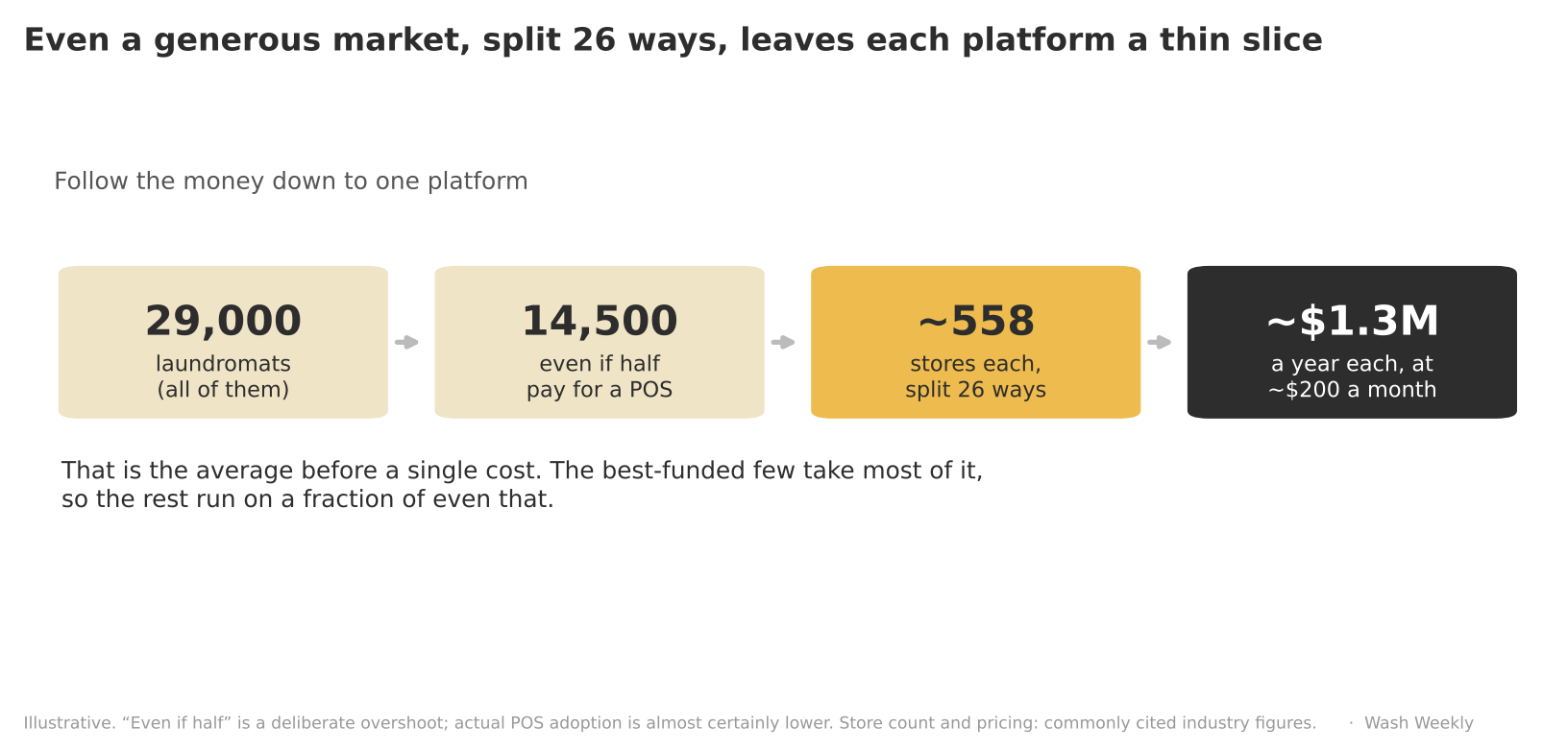
Let’s take the generous end of that. Say all 29,000 laundromats, and say half of them pay for a POS, which is probably too high, I’m willing to bet plenty still run on a cash register and pen and paper. That's about 14,500 paying laundromats. Spread those across 26 platforms, each charging somewhere in the low hundreds a month,² and the average platform is living on somewhere around $1 million to $1.7 million a year, before it pays any expenses.
We've run quite a few of them
We've used or demoed several of the systems on that 26+ list. Some were early stage when we tried them and some had been in the market for a while.
What I couldn't tell from the login screen or any of the dashboards was which companies were healthy and which were just surviving. The demos look the same for either type of company. The clean dashboard and features tell you the software runs. They tell you nothing about whether the company behind it is growing, holding steady, or quietly running out of runway.
The consolidation already started
It’s not a forecast, cause it's already happening. In 2022 Cents bought Starchup and folded it into its own POS.³ In 2025 PayRange, bought Turns and folded it into its platform.⁴ That's 2 POS platforms off the independent list in 3 years, absorbed by other companies in the laundry space.
We've watched the same thing play out on the equipment side, where two companies pulled 47 distributors together in 7 years. On the equipment side, the buyers were buying distributors for territory and market share. In software that may be the same play in some cases and in some probably just survival. Either way, the number of independent systems goes down.
A bigger market already ran this experiment
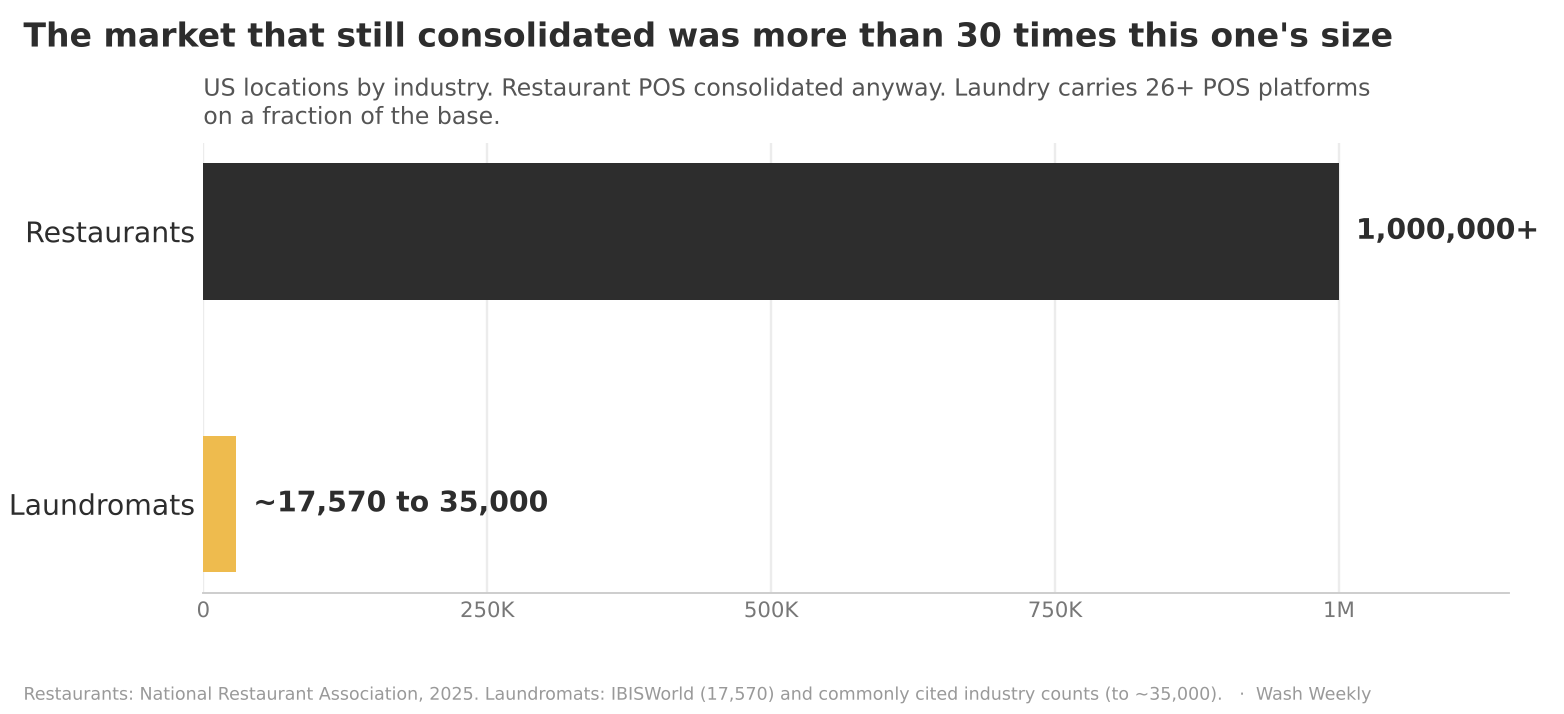
At times we tend to read a a lot of options as a sign the industry maturing. The restaurant business went through that experience years ago, at a scale we'll never reach. There’s more than 1 million restaurant locations in the country.⁵ If any market were big enough to carry a long list of independent POS platforms, it would be that one.
It didn't stay fragmented like ours. Capital pulled it together through growth and acquisitions. Toast powers about 20% of small and mid-sized restaurants in the United States. That market share has nearly doubled in 3 years, and it ended 2025 with 164,000 locations after adding 30,000 in a single year.⁶ Oracle got Micros, the restaurant POS that was the standard for decades, for $5.3 billion in 2014.⁷ Since then Shift4 brought Revel, Lightspeed got ShopKeep, Upserve, and Vend. Thoma Bravo took Olo private for around $2 billion, and American Express brought. Tock.⁸ A few players took the center and a long tail of smaller POS platforms survived around them.
Now put the two markets, restaurant, and laundromats side by side. Restaurants outnumber laundromats by more than 30 to 1 on location count, and that market still consolidated toward a handful of winners. We have more than 26 platforms dividing up a market that hasn’t figured out whether it's 17,000 laundromats or 35,000. Every one of our platforms is working a sliver of the revenue base the restaurant platforms fought over.
The question under the purchase
A real question an owner/operator faces runs deeper than which POS platform has the cleanest interface, the latest features or all the bells and whistles you want.
Every POS platform on the list is built to be chosen based on features. The demos show you the dashboard, the integrations, the app your client sees, the website, etc. None of it shows you the part of whether the POS is still running in 5 to 8 years or the company behind it can survive a market that appears to small to support them all.
There's a second half to that bet, and the restaurant market has shown us what it looks like. Once a platform wins enough of the market, it gains the power to change the economics on the businesses running on it. In 2023 Toast added a 99 cent fee to online orders over $10, then pulled it within a week after the restaurants pushed back. The CEO stated that the company made the wrong decision.⁹ In 2026 the FTC and several states sued Toast over how it charges, a case Toast denies and is fighting.¹⁰
The point isn't whether Toast behaved badly or not. It's that scale and market share hands the POS company leverage, and you inherit whatever it decides to do with that leverage.
The owner/operator who picks the POS platform that doesn't survive inherits a different problem. The migration, the retraining, the integrations that stop working, and the cost of training your team all over again on something new. We looked at what that kind of lock in costs once you're on a platform.
The feature list is the easy part to evaluate a POS. The hard part, the part I have never seen on a slide or in a demo, is the survival math of the company you're about to hand your operation to.
Thinking about the thinking of laundry:
Once you realize how crowded our market is, you stop weighing features so heavily and start weighing longevity and the people behind it.
That's all I got for you today.
Waleed
Your regulars already take their dry cleaning somewhere else.
Here's how to keep it → waleedcope.com/toolkits
Echoing the thoughts of R. Buckminster Fuller.
You never change anything by fighting it; you change things by making them obsolete through superior technology.
FOOTNOTES
¹ IBISWorld, US laundromats market size and number of businesses, 2026. The higher counts (~29,000 to 35,000) and the $5 billion revenue figure are the numbers commonly cited around the industry, which has no single authoritative count.
² Representative published 2026 pricing across laundromat POS platforms, for example Curbside Laundries and LaundryOS.
³ Cents Announces Starchup Acquisition, August 26, 2022.
⁴ PayRange Acquires Turns, February 2025.
⁵ National Restaurant Association, State of the Restaurant Industry 2025.
⁶ Toast Q4 and full-year 2025 earnings call, February 2026.
⁷ Oracle to Purchase MICROS for $5.3 Billion, 2014.
⁸ FT Partners, Restaurant Technology, October 2025 (Shift4/Revel, Thoma Bravo/Olo, Amex/Tock), and Lightspeed's acquisitions of ShopKeep, Upserve, and Vend, 2020 to 2021.
⁹ Toast to Remove 99-Cent Fee After Widespread Backlash, July 2023.
¹⁰ Toast is sued by the FTC over alleged hidden fees, October 2026.


