


Cut your detergent costs without cutting corners. Each pod is precisely dosed, so you only pay for what every load needs and nothing goes to waste. Businesses unlock wholesale pricing that improves the more you order.
Many times when franchising comes up in our industry, a similar statement is said. I'm not giving someone 6% of my gross for a name on the wall.
Many owner/operators and others in the industry I know have mentioned this. The royalty is one of the things we point at when we explain why we stayed independent. We run our own store, we pick our own equipment, we keep our own margin. Why hand a franchisor a cut of every dollar for the length of the agreement.
It's a fair question. The quieter question is the one I've been thinking about. If we're this adamant that 6% of gross is too much to give up, how much are we already giving up, and to how many others.
Why Franchise Royalties Get Scrutinized but Laundromat Fees Don't
A franchise royalty is easy to resist because it's easy to see, it's one number and it goes to one company. It lands on one expense line every month, and calculated off your gross. When something is that visible, you don’t miss it, and weigh it differently.
The fees that run a modern laundromat don't arrive that way. They come one at a time, from different companies, on different invoices. The machine payment system takes a percentage, the card processor takes another, the counter takes its cut at the POS, and the PUD software bills a monthly fee before taking a percentage on top. None of them is big enough on its own to stop you, so none gets weighed the way the royalty does.
That's the mechanism. A franchise royalty is one large deduction on your revenue that you see all at once. The others are a dozen of deductions you don’t as much, because they are spread out in smaller amounts and not on the same line.
The Two Kinds of Laundromat Fees: Revenue Linked and Flat
The fees split into two kinds, and it helps to look at which is which. Some are tied to your revenue. The processor, the payment system, the counter, the delivery platform all take a percentage of what comes in. Those scale with you. The better your year, the more they take, and you never reopen the conversation, because the rate didn't change, only the base did.
The others are flat. Bookkeeping software, payroll software (depending on which you have), scheduling software, the loyalty app, the marketing retainer. Each is a fixed monthly number that looks small next to a day's revenue. They grow a different way, by compounding on each other. You add one, then another, then the one a vendor told you that you needed, and the line gets longer every year.
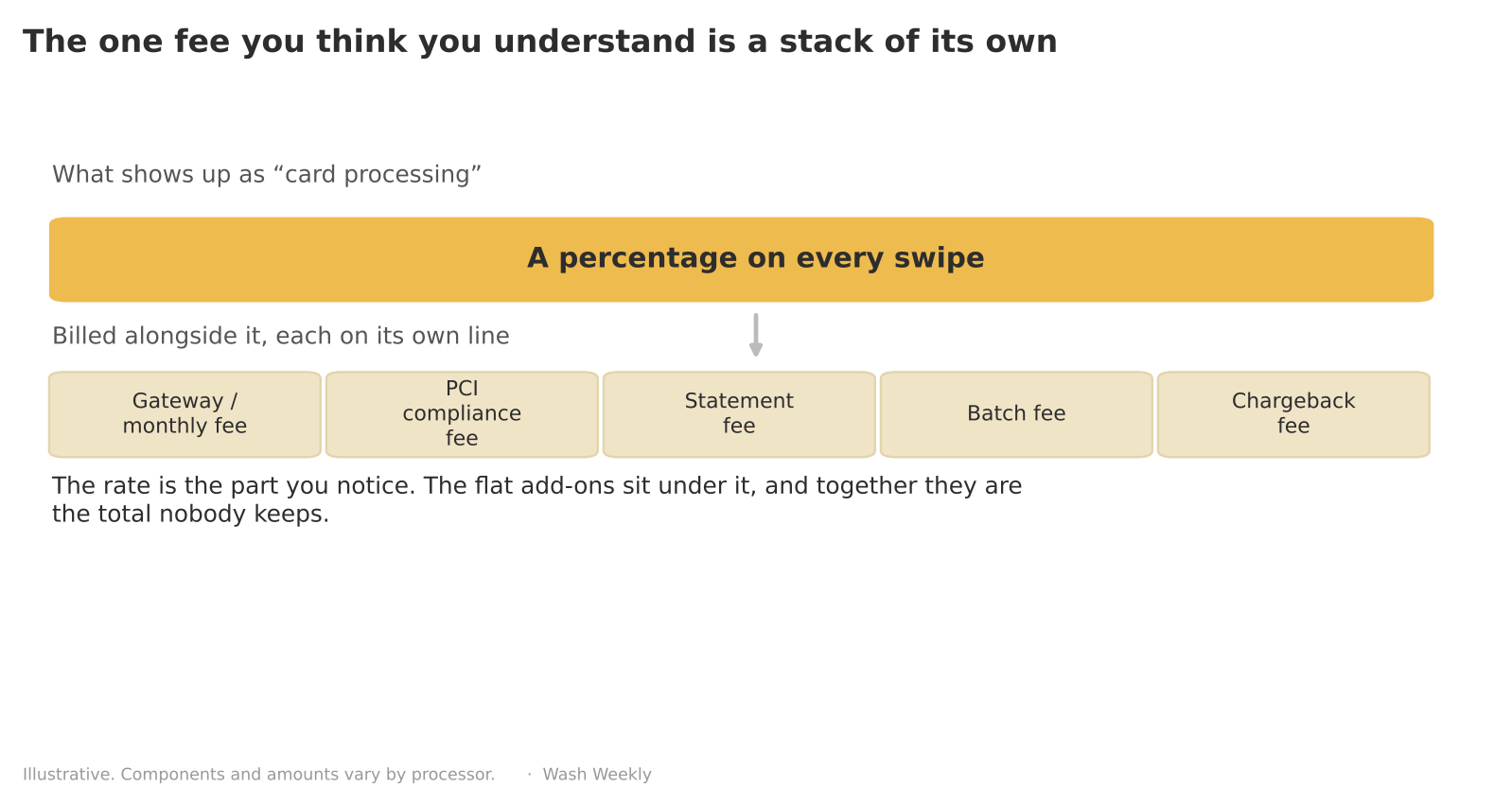
Then there's the part most of us never read. The processing fee isn't a fee. Open the statement and it's a stack of its own. A fee on each swipe, and beneath it a gateway fee, a PCI compliance fee, a statement fee, a batch fee, a chargeback fee. The one charge you thought you understood turns out to be fragmented too.
What One Store's Fees Add Up To
Here's roughly what it can look like at a store. The payment system on the machines, somewhere between 2.5% and 4% of what moves through it. Card processing, another 2.5% to 4% depending on the setup. The counter POS, the same range. The PUD software, $200 to $400 a month before it takes its own 2.5% to 4% on each order. A loyalty or marketing app, $90 to $200 a month.
Cut your detergent costs without cutting corners. Each pod is precisely dosed, so you only pay for what every load needs and nothing goes to waste. Businesses unlock wholesale pricing that improves the more you order.
Then the marketing company retainer, not counting ad spend. Several of the firms working our space charge somewhere between $400 to $800 a month to manage your ads and your SEO. That's the management fee. The ad spend is separate, and it's bigger. You're paying a monthly fee for the right to spend more money on top of it. I know owner/operators paying several thousand a month once you add the two together.