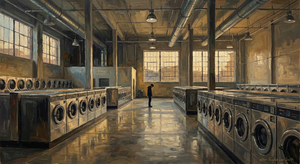

I was in an owner/operator's store recently, who owned multiple locations. Nice setup and layout.
An older lady came over twice to ask him about her dryer while we were talking. She was putting money in the machine. The owner's face? Pure disgust that she was asking him a question.
His team member, standing next to me, said, "It's like this all the time. They just be bugging us. It's so annoying."
The lady is spending money in his store. And he's annoyed.
That interaction stuck with me. Not because the owner/operator was rude or anything to the lady. But because of what happened next. The employee didn't learn that attitude from a training manual. He learned it by watching the owner/operator. The eye roll, the sigh, the body language.
In that second, the owner/operator sent a message. And the team member received it loud and clear, this is how we treat customers here.
That's not a customer service problem. That's a culture problem. And by the time it shows up in how your team talks, the damage has already happened.
What This Actually Costs
You might think this is just about attitude. A bad day here and there. It’s no big deal, Waleed.
But this pattern has been studied and documented. And the numbers are scary.
Globally, $3.7 trillion is at risk annually from poor customer experiences. In the United States alone, $856 billion. That rised by 19% from 2023 to 2024.¹ Something is getting worse, not better.
Here's why it matters for our laundry businesses specifically.
When your culture turns toxic, your team leaves. MIT Sloan found that toxic culture is 10.4 times more powerful than compensation in predicting whether employees quit.² Not twice but 10x more powerful. You can't pay people enough to stay in a place that feels bad.
And when they leave, that’s more lost revenue. The Society for Human Resource Management tracked culture driven turnover over five years. The cost to American businesses was $223 billion.³ One in five employees said they left specifically because of bad culture.⁴
Now think about what happens on the client side.
An unhappy customer tells 9 to 15 people about their experience. A happy one tells 3 to 5.⁵ That math works against us fast. It takes 12 positive experiences to undo the damage from a single negative one.⁶ And 91% of unhappy customers won't come back.⁷
This is how businesses bleed. Slowly. Invisibly. One frustrated interaction at a time.
The 70% Problem
Gallup found that 70% of how engaged your team is comes down to one thing, you.⁸
In a Fortune 500 company, there are layers between the CEO and the client. VPs. Directors. Managers. Supervisors. The CEO's bad mood might never reach the front line.
In a laundry business? We ARE the front line. There's no buffer. Our attitude radiates directly to our two, three, five team members. Who then interact with every single client who walks through our door.
Less than 10% of emotional communication happens through words.⁹ Our teams aren't learning from what we say. They're learning from our face, our tone, our body language.
That team member in the store didn't say "It's annoying" because someone told him to. He said it because he watched the owner/operator’s face when the lady asked for help. He picked up the real message.
The contamination happened in seconds.
It's Not Just Attitude
Here's what many owner/operators miss. Your team isn't just watching how we treat clients. They're watching everything.
We don't pick up trash on the floor? They're not going to pick it up either. We walk past lint and dust on the washer bases? They'll walk past it too. We don't grab a towel and wipe something down when you see it's dirty? Neither will they.
We don't think clients deserve a great experience? Guess what our team is going to think.
I was scouting a location once and visited a competitor nearby. The owners came in, spoke to a couple people, walked right past debris all over the floor and the front of the machines, and went straight to the back. No interaction with clients. No acknowledgment that anything needed attention. Their team saw that. Their team learned from that.
Everything is modeling. Our habits become their standards. Our indifference becomes their indifference.
The Cascade
Here's what happens next. That team member doesn't just absorb the attitude. He spreads it.
Picture this. Two of your employees are folding in the back. A regular clinet walks in. One says to the other, "Here she comes again. Watch, she's gonna complain about something." The other laughs. Maybe the client overhears. Maybe she just feels something is off. Either way, she doesn't feel welcome anymore.
Or worse. Your team starts venting about clients to other clients. "Yeah, some people just don't get how to use the machines." Now you've got employees creating negative word of mouth inside your own store.
This is the cascade. Owner frustration becomes team frustration. Team frustration becomes visible contempt. Visible contempt becomes client experience. Client experience becomes reputation.
And you might never know it's happening. Because nobody is going to tell you that your team talks about clients behind their backs. You just notice that revenue is flat. That regulars stopped coming. That something feels different but you can't name it.
The Prayer Paradox
I had another operator tell me his store was crowded and it was "just annoying." He said it was "disgusting" how many people were in there.
Think about that for a second. How many owner/operators ask the universe for their business to grow? Pray for more clients? Then when it happens, they complain about it.
You think Chick-fil-A complains when it's packed on Saturday? You think the owner of that location is saying "It's so crowded, we need to raise prices and chase people out of here"?
When myself or my brother walk into VIP Bubbles and it's crowded, we're running around trying to help people, making sure they have a good experience. Our team is doing the same and if they aren’t my brother is all over them explaing why it’s important to. We're grateful the store is packed. I want it crowded every day.
When you're annoyed by success, something has fundamentally broken. That's not a bad day. That's the cynicism stage. And your team sees it.
What We Do Differently
Clients can push the limit. There are moments when frustration creeps in. I'm not immune to it.
But here's what we've learned over time.
Model the behavior. My brother, our manager, and I run around the store. We help people. We engage. We pick up the trash. We wipe down what's dirty. We carry bags. We escort people to and from the parking lot. The team sees that.
Vent in private. When a client gets us upset, we don't vent on the floor. We talk about it in the car. On the phone. Outside. Away from the team. Why train my team that complaining about clients is normal or even acceptable.
Don't spread the drama. When something goes sideways with a client, I don't go back to the team with the whole story. I had a guy trying to commit credit card fraud with our pickup and delivery service. Twelve stolen cards on file. I called him directly, handled it calmly, and it was done. When my team asked, I just said "He has some issues with his card. He won't be ordering anymore. If he does, he's gotta pay cash." That's it. No need to replay the drama. Give the solution, not the story.
Reframe when frustration hits. When I feel it creeping in, I pull up the client's order history. Their visit count. Their yearly spend. 47 visits. $2,400 this year. That's someone who chose us 47 times. That quickly reframes the frustration for me and most times it disappears.
Thinking about the thinking of laundry:
When you realize your team learned how to treat clients by watching you, not listening to you.
The question worth asking, have I started viewing clients as interruptions instead of the reason I'm in business?
If the answer makes you uncomfortable, good. That's the awareness before the damage spreads.
That's all I got for you today.
Waleed
PS: PRESSED: A private network for serious laundry operators who are done with the noise. Invite only. Sign up to get notified when applications open: joinpressed.com
Echoing the thoughts of Ralph Waldo Emerson.
What you do speaks so loudly that I cannot hear what you say.
Share these insights
Did you enjoy this editorial? Forward it to colleagues and friends so they can subscribe. Was this editorial forwarded to you? Sign up for it here.
Footnotes:
¹ Bad Customer Service Threatens $3.7 Trillion Annually - Qualtrics XM Institute, 2024
² Toxic Culture Is Driving the Great Resignation - MIT Sloan Management Review, 2022
³ The High Cost of a Toxic Workplace Culture - Society for Human Resource Management
⁴ Why Every Leader Needs to Worry About Toxic Culture - MIT Sloan Management Review, 2022
⁵ Customer Service Facts - White House Office of Consumer Affairs
⁶ Understanding Customers - Ruby Newell-Legner
⁷ Word of Mouth Marketing Statistics - Review42, 2024
⁸ State of the American Manager - Gallup
⁹ Emotional Contagion in Organizational Life - Research in Organizational Behavior, 2018