
What Nobody Tells You About Year One
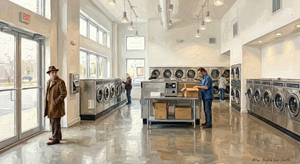
Eric Welch built Emma's Laundromat from scratch in Lewisville, Texas. New construction, his vision, his colors, his setup. He posted a video on January 22nd giving an update on where things stand eight months in.
"Revenue got to track right, and we're tracking. We're just not tracking fast. It's a little nerve-wracking, a little stressful. Hindsight 20/20, maybe we should have purchased a small one, had some income coming in, renovated it over time. We didn't do that. We built from scratch."
Then he said something we don't see in laundry posts.
"Pray for us."
That line really pulled on my heartstrings.
The Silence Nobody Breaks
Most laundry content online falls into predictable categories. There's the "laundromats are great passive income" crowd selling the dream. There's the interview-based educational content where successful owners share how they made it. There's the viral money counting videos optimized for likes and engagement. And there's the day-in-the-life vlogging where someone talks about picking up laundry bags, dealing with a broken machine, etc.
None of that is wrong. But notice what's missing.
Almost nobody talks about being in the middle of it while the outcome is still uncertain but, Eric did. He's not talking about a machine that broke or a difficult client. He's talking about something that could end his business if it doesn't turn around. He's eight months into a new build, revenue isn't tracking where it needs to be, and he's putting that out there publicly while the outcome is still unwritten.
Research shows 27% of entrepreneurs feel they can never show vulnerability or weakness.¹ The internet rewards the appearance of success, not the reality of building it. So we get highlight reels and hindsight stories, not real time honesty.
And here's the thing about being an entrepreneur that nobody talks about. Who can we actually express this stuff to? We can't vent to our employees, "Hey, sales are down, not sure how I'm gonna make payroll". We can't complain to vendors who need to believe we’re good for the money. Friends and family who aren't entrepreneurs? They either don't understand or hit us with "told you not to buy a laundromat."
We’re supposed to have the game face on all the time. So we carry it alone.
The Ramp Up
Here's what the data actually says about building a business.
Most small businesses take two to three years to become profitable.² Capital intensive businesses like laundromats often take longer. Only 40% of small businesses are profitable at all.³
The survival rates tell a similar story. According to the Bureau of Labor Statistics, 20.4% of businesses fail in year one. By year five, 49.4% have closed. By year ten, 65.3%.⁴
Those numbers sound brutal. But flip them around. If half of businesses fail by year five, that means half make it. If you're in the middle of it right now and it feels impossible, you're not failing, you're in the timeline. The question is how you become part of the half that survives.
This isn't failure. This is the ramp up.
Here's where I need us to be really aware. When people share about going profitable in months or hitting their numbers in the first year, that's not normal. That's the exception, not the rule. And sometimes when you dig into those numbers, they're not even calculating profitability correctly. I've heard operators say they're profitable while not counting rent because they own the building. That's not how it works. Rent is a cost whether you pay yourself or a landlord.
The highlight reel online creates a distorted picture. If you're measuring yourself against that, you're measuring yourself against something that isn't real. Please be careful.
No One is Immune
When Eric said what he said, it hit me because I've been there. I know that feeling. And I'm going through a version of it again right now.
I'm in the middle of a project, and cash is going out as fast as it comes in some weeks. I've been doing this since I was a kid with my dad. I can tell you, the struggle doesn't disappear. It just changes form. Whether you have one location or twenty, there's always something. The checks just have more zeros.
Some weeks I wonder if I'm doing this right. Whether the decisions I'm making are the right ones. That doubt doesn't mean you're failing. It means you're paying attention and not being complacent.
Here's what I know, the isolation makes everything worse. The silence around struggle creates shame. The shame creates more silence. And the cycle continues.
Eric broke that cycle by saying out loud what most of us only think. That matters. There's no shame in being honest about where you are and what you're facing. Because when you're open about it, you give other people permission to help. If nobody knows, nobody can.
Why It Matters
The psychological toll of entrepreneurship is real. 72% of entrepreneurs report being affected by mental health conditions.⁵ 49% deal with at least one mental illness.⁶ Nearly half experience high stress levels.⁷ And the isolation compounds it, 50% of CEOs report feeling lonely, with 61% believing it hinders their performance.⁸
This isn't weakness. This is the weight of building something while the outcome is uncertain.
Research from Durham University found that the gap between entrepreneurial expectations and reality creates anxiety, isolation, shame, and guilt.⁹ When everyone online is showing their wins and you're grinding through month eight wondering if you made a mistake, that gap feels enormous.
Here's my ask. Be intentional about what you let into your feed. You're the sum of the content you consume. If your social media is full of "I made six figures in my first year" that's going to affect how you see your own progress. Unfollow what isn't serving you. Find the people who are being real about the journey, like Eric, and connect with them.
Being an entrepreneur is hard. It's supposed to be. If it wasn't, everyone would do it. The difficulty is what filters people out. So when it's hard, reframe it, good. Less competition. The people who can't handle the ramp up will never get to where you're going.
Thinking about the thinking of laundry:
When you realize the struggle you're feeling isn't a sign you're failing, it's the price of admission.
The ramp up is measured in years, not months. If you're in the middle of it, it feels relentless. That's not failure. That's the timeline.
The question is whether you're building alone or building alongside others who get it.
Building a business is brutal. But you don't have to do it in silence. Eric put himself out there. That took courage. Maybe more of us need to do the same.
That's all I got for you today.
Waleed
Echoing the thoughts of Brené Brown.
Vulnerability is not winning or losing; it's having the courage to show up and be seen when we have no control over the outcome.
Footnotes:
¹ FreshBooks Self-Employment Report, 2019
² Forbes: How Long Until a Business Becomes Profitable?, 2023
³ FreshBooks Small Business Financial Literacy, 2019
⁴ Bureau of Labor Statistics Business Employment Dynamics, 2024
⁵ UC Berkeley Entrepreneurship & Mental Health Study, 2015
⁶ NIMH Statistics on Mental Illness
⁷ Gallup State of the American Workplace, 2023
⁸ Harvard Business Review: The Loneliness of the CEO, 2012
⁹ Durham University Business School: MIND Your Business - Tackling the Mental Health Crisis in Entrepreneurship
¹⁰ Eric Welch Facebook Video - January 22, 2025