My brother and I were going over the numbers at the store recently. Routine review. Then we noticed something that swung the conversation.
Clients were using credit cards to start the washers and dryers.
Not wash and fold. Not pickup and delivery. The self-service machines. We said this isn’t good, this is a trend we need to watch closely.
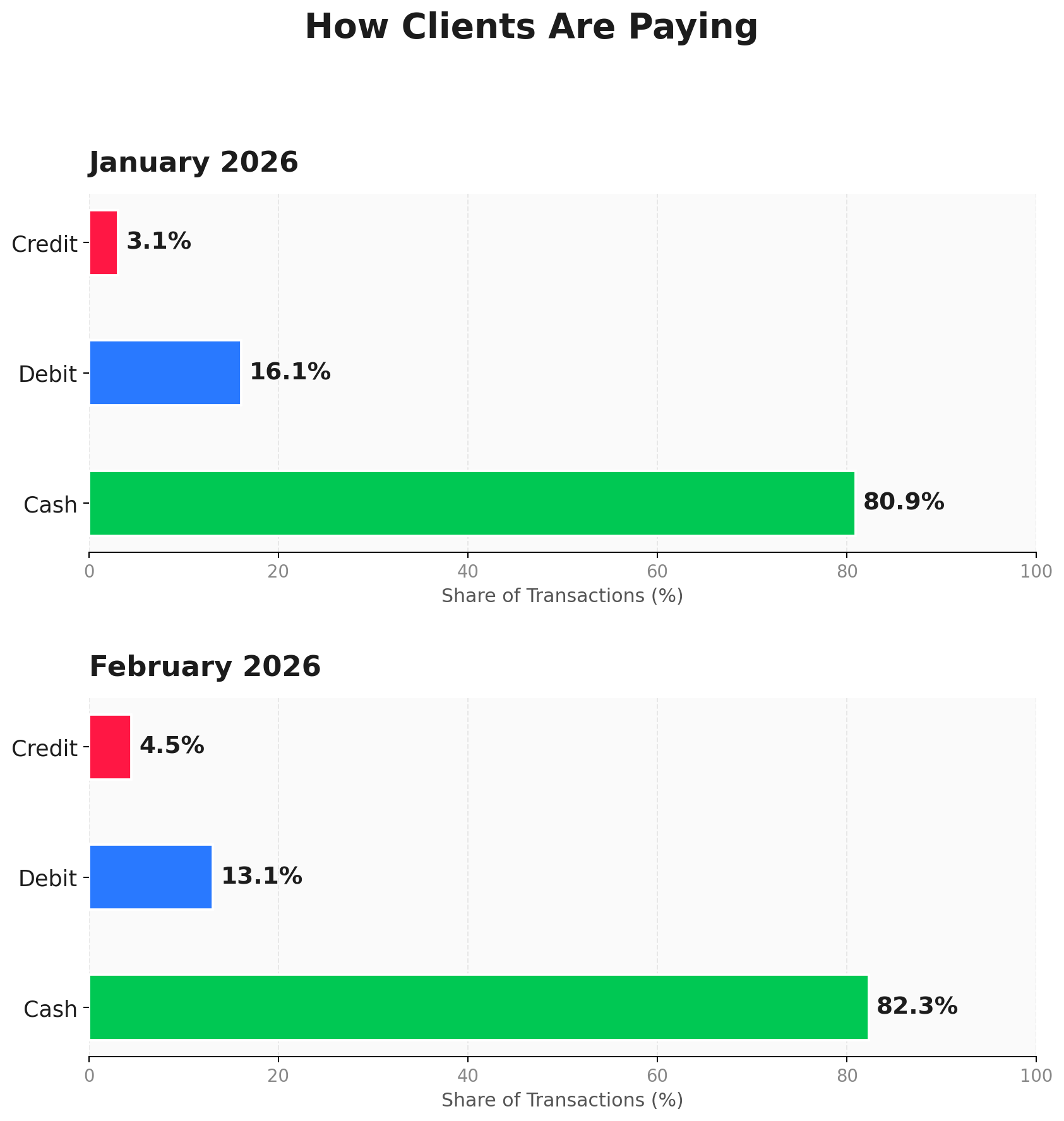
In January, 3.1% of transactions at the mat were paid by credit card. In February, that number climbed to 4.5%. Cash remained dominant. But credit was moving in one direction.
Before we go further, context matters. This is one store, in one market. A mat in different types of communities will show different, transaction volumes than one in another market. That's why percentages matter more than raw numbers here. The share tells the story.
And the story is worth paying attention to.
The Assumption We've Been Leaning On
There's a belief that runs through our industry like a law of physics.
"People always need clean clothes."
It's somewhat true. But it's not a complete thought. And incomplete thinking is exactly where industries get caught off guard.
People want clean clothes, but they don't necessarily need your laundromat to get them clean. And when financial pressure builds long enough, people are remarkably creative about finding another way.
What Other Industries Learned the Hard Way
Fast food built its entire identity around being affordable. That was the whole value proposition. Then, between 2019 and 2024, menu prices rose 33% above pre-pandemic levels.¹ McDonald's reported its first global same store sales decline in 13 quarters.² Households earning under $50,000 didn't complain loudly. They just started cooking at home instead. They didn't go hungry. They adapted.
Cable TV had 88% household penetration at its peak.³ Nearly nine out of ten American homes were paying for it. The industry raised prices year after year, assuming the product was essential enough that people would absorb whatever came. By 2024, penetration had dropped below 50%.⁴ When researchers asked cord cutters why they left, 86.7% cited price as the primary reason.⁵ They didn't stop watching television. They found a cheaper (better) way for them to do it.
The pattern in both cases is identical. Consumers didn't go without. They adapted. And the industries that assumed "essential" meant "captive" found out otherwise.
What the Consumer Data Is Actually Saying
The median household income of a laundromat client is $28,000 a year.⁶
Sit with that number for a moment. That's who we serve. And right now, that household is under more financial pressure than it has been in over a decade.
In the third quarter of 2024, the share of active credit card holders making only the minimum payment hit 10.75%, the highest level recorded in data going back to 2012.⁷ Credit card charge-offs, when a borrower stops paying entirely and the bank writes the debt off as a loss, hit a 13-year high in that same period.⁸ A recent survey found that 25% of buy-now-pay-later users are financing groceries, nearly double the share from a year prior.⁹
That's what the data is saying.
Here's what it isn't saying. How many of those households are walking into laundromats right now. Nobody's tracking that. But the math isn't difficult. A meaningful slice of the people sitting in your mat today are already at their financial ceiling before the machine starts.
And here's the detail that doesn't show up in any survey. Some clients aren't using credit cards at the kiosk. They're pulling cash advances on their credit cards to do laundry. A cash advance typically carries an interest rate of 25 to 30%, sometimes higher, with fees on top.¹⁰ That means someone is effectively paying $7 or $8 for a $5 wash when you factor in the cost of borrowing. They're not doing this because they're careless with money. They're doing it because they're out of options.
That's not a credit card swipe. That's someone standing near the edge.
Essential Doesn't Mean Captive
There's a difference between price sensitivity and a breaking point.
A price sensitive client is always hunting for the cheapest option regardless of experience. That's not who we're talking about. What we're talking about is a threshold, the point where the price exceeds what someone can absorb. Not because they're comparison shopping, but because they've been pushed past what their budget allows.
These are clients who liked your store. Kept coming back. Are now financing a basic necessity on a credit card with 25% interest.
That's not sensitivity. That's capacity. And capacity has a ceiling.
When fast food stopped being the affordable option, households didn't go hungry. They cooked or shifted to more affordable options. When cable got too expensive, people didn't stop watching TV. They found Netflix. And when laundry gets too expensive? They'll wash clothes in a bathtub. They'll drive to a relative's house and hand them a couple bucks. They'll find a cheaper way. They'll do fewer loads.
People are resourceful. They will figure out another way when forced to.
The behavioral shift doesn't announce itself. It's quiet. One fewer visit per month. One load instead of two. One client who just doesn't come back.
You don't always see it happening until it's already happened.
Are You Watching Your Data?
If you have a card or electronic payment mat, you have access to data we never had before in the industry. You can see not just how much clients are spending, but how they're choosing to pay.
Cash still dominates at our mat, as it likely does at yours. But credit moving from 3.1% to 4.5% in a single month, in a market we know well, that got our attention. Not because it's a crisis (well not yet). Because it's a direction.
If you're still running a coin only operation, don't take this as irrelevant to you. People pull cash advances on credit cards. That cash ends up in your coin machine. The signal is harder to see, but it may be there.
The question worth asking isn't whether your clients are struggling. It's whether you're paying close enough attention to know.
Thinking about the thinking of laundry:
When you realize your clients will wash clothes in a bathtub or drive to a relative's house before they'll go broke doing laundry, you start to understand that essential and captive market are two very different things.
The data is available to you. The signal is already there. The only question is whether you're looking for it.
That's all I got for you today.
Waleed
P.S. Connect with me on LinkedIn, YouTube, or X (Twitter)
Echoing the thoughts of Muhammad Yunus.
In my experience, poor people are the world's greatest entrepreneurs. Every day, they must innovate in order to survive.
Footnotes:
¹ Fast Food Price Increases Since 2019 - Restaurant Business Online, 2024
² McDonald's Same-Store Sales Decline - PYMNTS, 2024
³ Cable TV Peak Penetration - Leichtman Research Group
⁴ Cable TV Cord-Cutting Statistics - Statista, 2024
⁵ Cord-Cutting Reasons Survey - Variety, 2023
⁶ Laundromat Customer Median Household Income - Press Cleaners / The Laundry Bag, 2025
⁷ Minimum Credit Card Payments Hit Record - CNBC, January 2025
⁸ Credit Card Charge-Offs Hit 13-Year High - National Creditors Bar Association, 2024
⁹ BNPL for Groceries Rising - CNBC, April 2025
¹⁰ Credit Card Cash Advance Rates and Fees - NerdWallet, 2025