

My business partner/brother has a line he says to me whenever we're discussing the numbers and growth at the mat.
"Beware of little expenses; a small leak will sink a great ship."
That's Benjamin Franklin. Poor Richard's Almanack, 1758.¹ My brother didn't get it from an almanac. He got it from watching what happens inside a business when nobody's paying attention to the small stuff. A percentage point here. A fee there. A charge that's been sitting on the statement so long it feels like rent.
We say the short version, "a small leak" and we both know exactly what it means. It means the thing that's costing you money isn't always the thing you'd notice.
Here's what got me thinking about this more broadly. When my brother and I talk about growing the business, we talk about getting more clients, but not as much as you might think. We're talking more about what's happening inside the operation. Where's the waste? What's leaking? What can we tighten? And how much of what we're already making is quietly walking out the door before it ever reaches profit?
That's a conversation worth having more often.
The Math That Changes the Conversation
There's a concept in supply chain management called the profit-leverage effect. The idea is simple. A dollar saved on expenses drops straight to the bottom line. Every cent. A dollar of new revenue doesn’t, it has to cover the cost of earning it first.²
Here's how that works in practice. Say you're running a laundromat that does $400,000 a year in gross revenue with a 25% net margin. That means $100,000 in net profit and $300,000 in total expenses. If you want to add $15,000 to your profit from the revenue side, you'd need to generate $60,000 in new revenue, because at a 25% margin, only a quarter of every new dollar drops to the bottom line. The other $45,000 goes to cover the costs of earning it. But if you find $15,000 in cost reductions across your expense categories, every dollar of that goes straight to profit. Same result. One path requires four times the effort.
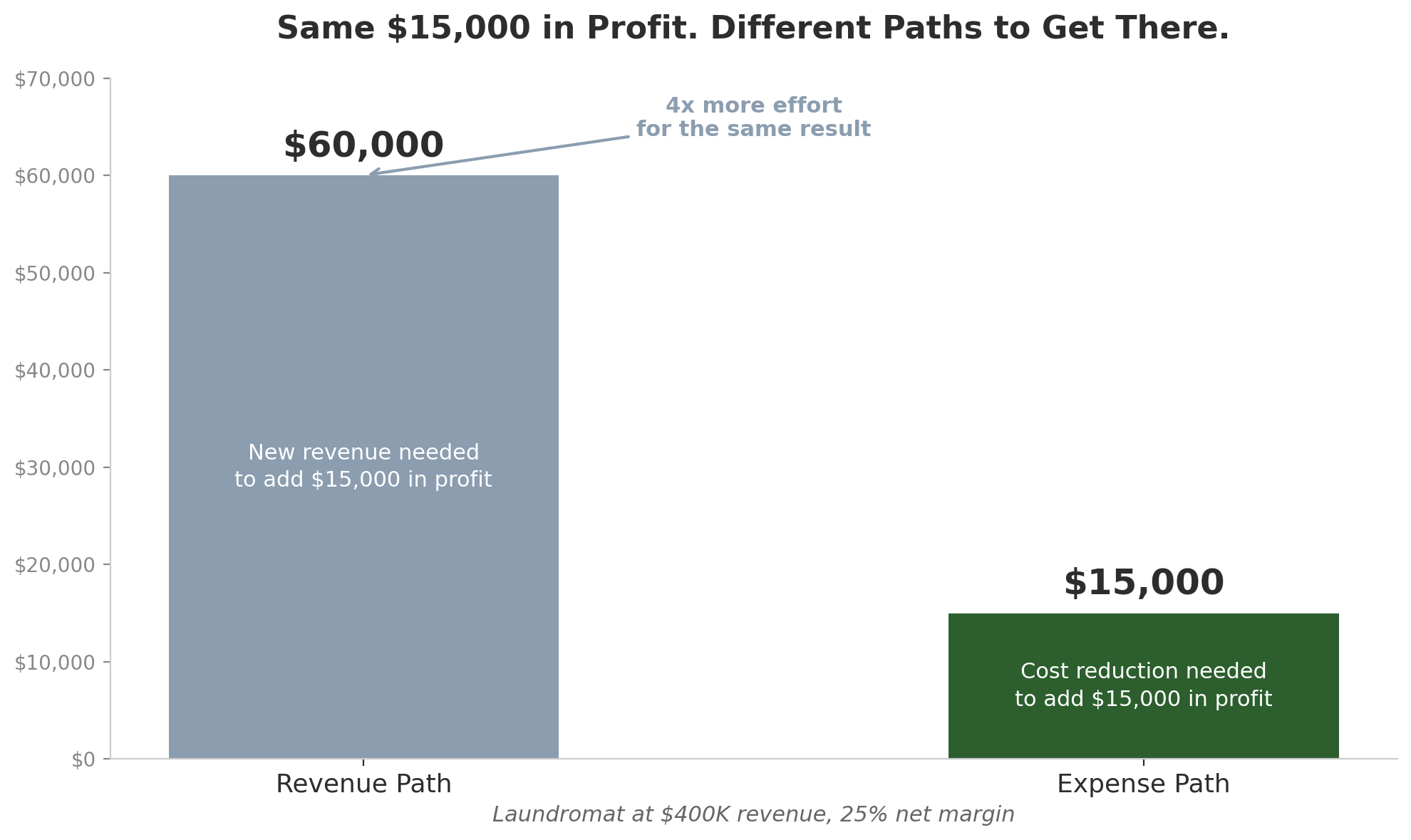
McKinsey analyzed the income statements of S&P 1500 companies and found that a 1% reduction in variable costs improved operating profit by 5.3%. A 1% increase in sales volume? That improved operating profit by 3.3%.³ The cost side was 60% more effective as a profit lever than the revenue side.
That ratio holds at every scale. Whether you're Hilton managing thousands of properties or an owner/operator running a single mat, the math works the same way.
Where the Conversation Tends to Live
Jay Abraham, the growth strategist, is famous for identifying the three ways to grow any business, get more clients, increase the average transaction, and increase the frequency of purchase.⁴ It's a brilliant framework. And most of the industry conversation, from events to Facebook groups to YouTube, tends to live on the first one, more clients, more volume, more growth.
There's nothing wrong with that. Getting clients in the door matters. But it's worth noticing what that framework doesn't include, a lever for keeping more of what you're already making.
There might be a reason the conversation stays there. There's a well documented pattern in behavioral research called action bias. Researchers studying soccer penalty kicks found that goalkeepers almost always dive left or right, even though statistically, staying in the center gives them the best chance of making a save. Diving and missing feels better than standing still and watching the ball go by. Doing something visible feels like progress, even when it's not the optimal move.⁵
Launching a new marketing campaign feels like diving. Auditing your utility bill feels like standing in the center.
It's also worth noticing where the energy goes at industry events and in trade publications. The booths are for equipment, payment systems, marketing platforms, software. Those are all revenue side tools. The expense side of the P&L doesn't really have a booth (with the exception 4Ward Energy, Chris Ward). There's no trade show presentation called "renegotiate your processing fees." Not because the ROI isn't there, but because optimizing what you already have isn't a product anyone can sell you.
That doesn't make anyone wrong. It just means the conversation naturally gravitates toward one side of the P&L. And the other side sits there, quietly compounding.
What It Actually Looks Like
Let me walk through what we've done at our store. None of this is glamorous. All of it moved the needle.
One of the bigger structural changes we made was with maintenance. We used to call our repair guy when something broke. He'd come out, fix it, charge us his rate plus parts off his truck (marked up), because he's carrying them around. We were reactive, and we were paying for it.
We switched to a retainer. Flat fee a week for a standing appointment, Thursdays, so everything is ready for the weekend. Two hours of scheduled work. If he goes over, we negotiated a lower hourly rate. And I started buying common parts myself and keeping inventory, because the markup on parts off a service truck adds up.
The cost went from unpredictable to fixed. The machines were getting maintained before the rush. And when you factor in the avoided emergency repairs, the reduced downtime, and the parts savings, the cost dropped meaningfully. The U.S. Department of Energy's Federal Energy Management Program found that preventive maintenance costs roughly 25-30% less than reactive maintenance, and that's just the direct cost. It doesn't account for the revenue lost when a machine is down during peak hours or the client who walks to the laundromat down the street and doesn't come back.⁶
That was a structural shift. But the smaller, recurring savings added up just as much. Here are some of the areas we've tightened:
Processing fees. We audited our credit card processing, our POS fees, our PUD payment system. Processing fees tend to creep up quietly, Visa and Mastercard update interchange rates, and those incremental increases don't announce themselves on any single statement. We renegotiated and got them down. Even one percentage point on processing fees, applied across every transaction for a year, adds up fast.
Utilities. This is the biggest line item in most laundromats. The CLA identifies utility costs as the single largest operating expense in a coin laundry.⁷ Ghost leaks from faulty valves or dripping water that runs overnight. Lights left on in a store that closes at 10 PM. Dryers running longer than necessary because lint screens aren't being cleaned regularly. Shopping alternative energy providers, people like Chris Ward at 4ward Energy will look at your current bill and negotiate with other providers on your behalf. Even modest improvements here move the needle because the base is so large.
Scheduling. Looked at when we had staff on versus when we actually needed them. Adjusted hours to match demand patterns. Reduced overtime. This is one of the areas where I think there's real opportunity across the industry, scheduling based on data rather than habit.
Insurance. When's the last time you got quotes from other providers? Increasing a deductible or bundling coverage can reduce premiums by 15-30%.⁸ It takes a few phone calls.
Bank fees. This one's almost embarrassing to mention because of how simple it is. We looked at what the bank was charging us monthly. Service fees, transaction fees. We asked questions. We switched some accounts. Saved money. I had a conversation with our business banker (if you don’t have one, get one), and they credited us for past fees.
Supply waste. Over-pouring detergent in wash and fold. Using more bags than necessary because orders aren't being packed efficiently. Cleaning products used without measuring. Each one is small. In aggregate over a year, it's real money.
Employee theft. This one's uncomfortable to talk about, but it's real. And it's not just cash out of the register, coin boxes or change machine. It's free washes given to friends. Voided wash and fold orders where the payment goes in someone's pocket. Starting machines for people off the books. Products walking out the door. Side jobs done in the store after hours using your equipment, your supplies, your utilities, and none of that revenue touches your books. It happens more than most owner/operators want to believe.
None of these areas represent dramatic savings individually. But here's what it looks like when you put them together.
Using that same $400,000 laundromat as an example, with $300,000 in total expenses, here's what conservative improvements across these seven areas could look like:
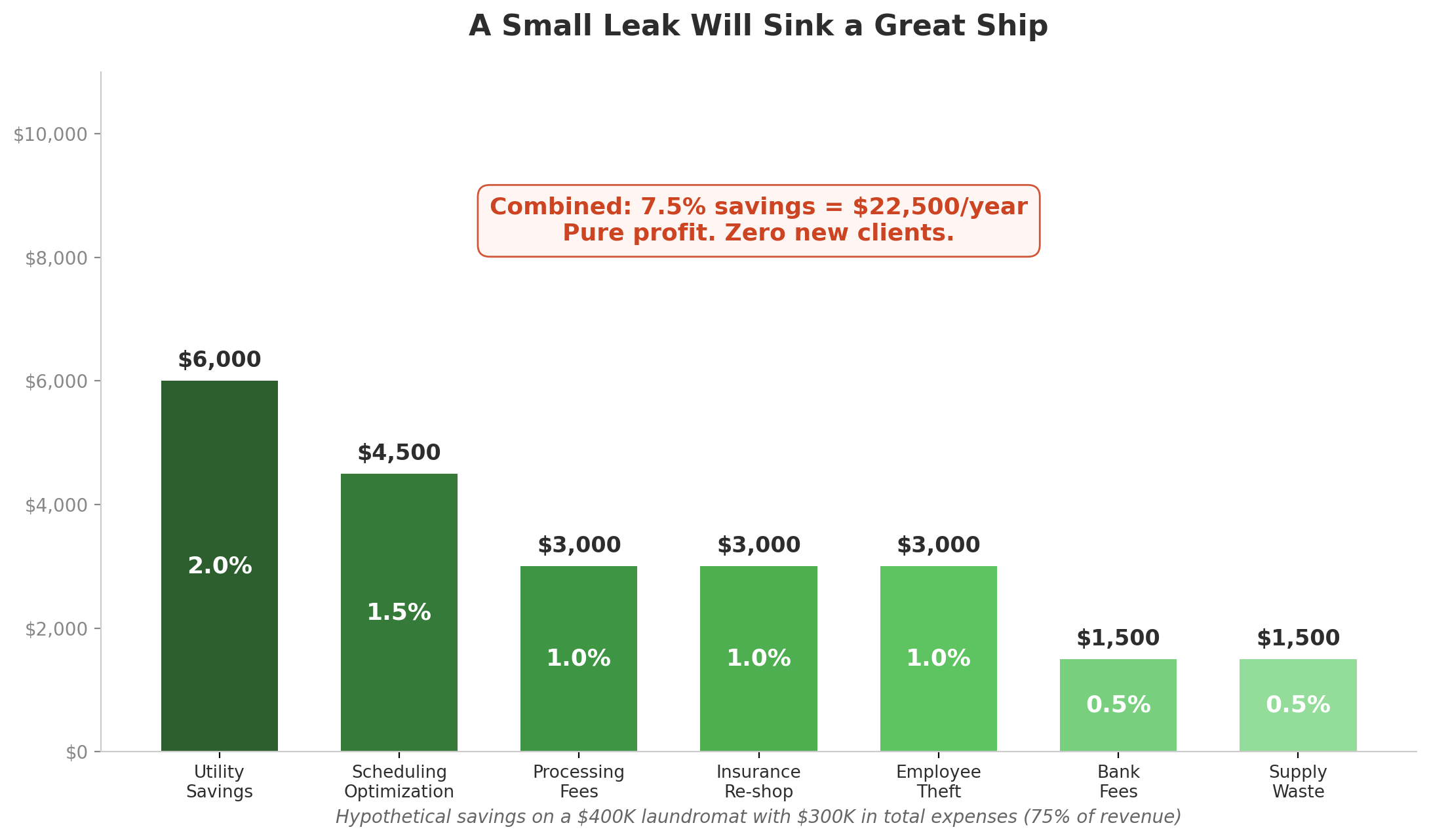
Utility savings at 2%. Scheduling optimization at 1.5%. Processing fees, insurance, and employee theft each at 1%. Bank fees and supply waste each at 0.5%. Individually, none of these numbers are aggressive. Combined, they represent 7.5% in total savings — roughly $22,500 a year that goes straight to the bottom line.
That's a 22.5% increase in profit on a mat already netting $100,000. No new clients. No new services. No added complexity.
And to generate that same $22,500 from the revenue side? At 25% margins, you'd need $90,000 in additional revenue.
The Billion Dollar Version of This
Hilton Hotels didn't add a billion dollars in profit by building more hotels. They found it inside the properties they already operated.
Their LightStay energy management program, mandatory across all Hilton properties since 2008, achieved more than $1 billion in cumulative savings through energy, water, and waste optimization.⁹ One property, a DoubleTree, cut electricity per room from 40 kWh to about 20 kWh in a single year. That's a 50% reduction at one location. Multiply that principle across thousands of properties, and you get a billion.
Hilton didn't invent new technology. They measured what they were already spending, found the waste, and eliminated it systematically. The boring work compounded.
What's Hiding in Your P&L
Research estimates that small businesses lose 20-30% of annual revenue to operational inefficiency, rework, miscommunication, duplicated effort, and unmonitored costs.¹⁰
Think about where that might show up in a laundromat. Software subscriptions signed up for and stopped using but never canceled or over sold on what you really need for the business. Insurance policies that haven't been quoted in years. Scheduling that runs on habit instead of demand. Maintenance handled reactively because a preventive calendar was never built. Supplies consumed without anyone measuring the rate.
Each one is individually small enough to overlook. That's exactly why they persist.
But collectively? On a single location mat, these can add up to tens of thousands a year, and even more for a multi-location operation. And because they're recurring, they compound, not in your favor, but against it.
Every dollar of that leakage is a dollar of pure profit that isn't being captured. And to replace it from the revenue side, the math says you'd need four dollars in new business for every one dollar that's quietly walking out the door.
Thinking about the thinking of laundry:
When you realize a dollar removed from your expenses does more for your profit than four dollars added to your gross revenue.
The conversation around growth will always carry more energy than the conversation around efficiency. That makes sense. Building something new is exciting. But the math doesn't care about excitement. It just measures what drops to the bottom line.
Franklin said it almost 270 years ago. A small leak will sink a great ship. My brother didn't need to hear it twice.
That's all I got for you today.
Waleed
Echoing the thoughts of Antoine de Saint-Exupéry.
Perfection is achieved, not when there is nothing more to add, but when there is nothing left to take away.
Footnotes:
¹ Benjamin Franklin, Poor Richard's Almanack — "The Way to Wealth," 1758
² The Profit-Leverage Effect in Supply Chains — NC State University, Supply Chain Resource Cooperative
³ The Power of Pricing — McKinsey & Company
⁴ Jay Abraham's Three Ways to Grow a Business — The Abraham Group
⁷ Industry Overview — CLA, The Laundry Association
⁸ The Small Business Insurance Audit — ABC17 News / Stacker, 2025
⁹ Hilton's AI-Driven Energy Management Achieves $1 Billion Savings — ei3 Corporation
¹⁰ The True Cost of Operational Inefficiency — Crebos, citing IDC Research