
The headlines say the economy is strong. GDP grew 4.3% in Q3 2025.¹ Unemployment sits at 4.4%.² Consumer spending keeps climbing.³
But I've been digging into the Federal Reserve's own data lately. And it tells a different story, at least for small businesses.
What the Fed Data Shows
The Federal Reserve's 2024 Small Business Credit Survey dropped recently. For the first time since 2021, more small businesses reported revenues decreased than increased.⁴
That's not a continuation of a trend. That's a turning point.
The survey revealed five stress indicators that caught my eye:
- 75% of small businesses cite rising costs as their top challenge.⁴
- 56% are struggling to pay operating expenses.⁴
- 39% have less than one month's cash on hand.⁴
- 82% of small business failures involve cash flow problems.⁶
And here's the one that connects it all, new small business lending dropped nearly 35% year over year according to the Kansas City Fed's national survey.⁵
I had to read that again. Costs are up. Cash reserves are down. And credit lifeline is shrinking.
The Two Tier System Not Talked About
J. Paul Getty once said: "If you owe the bank $100, that's your problem. If you owe the bank $100 million, that's the bank's problem."
That quote explains more about small business lending than any economic report I've read.
The Kansas City Fed documented 13 consecutive quarters of tightening credit standards for small businesses through the end of 2024.⁷ Meanwhile, the Federal Reserve's Senior Loan Officer Survey shows conditions have actually eased for large and middle market firms, larger credit lines, narrower loan spreads, more flexibility.⁸
Same economy, different rules.
When a corporation owes $100 million and hits trouble, the bank restructures. They negotiate. They extend terms. They work with you, because now it's their problem too. They have skin in the game.
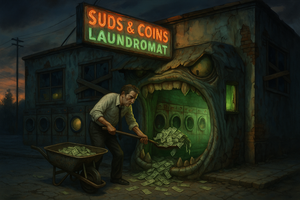
When you owe $500,000 on your laundromat and hit trouble? You're a line item. A write off.
This isn't conspiracy. It's math. The bank's incentive to help you survive is directly proportional to how much they stand to lose if you don't. And for most small business owners, that number isn't high enough to matter to them.
What I'm Hearing from Owners/Operators
I've been paying attention even more to conversations in our industry lately. The pattern matches the Fed data.
Operators tell me they're being put through more hoops to get financing, even with laundry specific lenders. Not the local banks. The institutions that were set up specifically for our industry. Taking longer to get approved. More documentation required. More boxes to check.
In conversations with owner/operators and brokers, I'm hearing more cases where stores are for sale due to financial difficulty, not retirement, not aging out, but struggling to make the numbers work for them. It might not be discussed outright in the listing, but it comes up later on.
I'm not claiming causation. I'm just noticing the parallel between what the Fed data shows and what I'm hearing in the business.
Wall Street vs. Main Street
There's an old saying, when Wall Street catches a cold, Main Street catches pneumonia.
Small businesses employ 46% of private sector workers in this country.⁹ We’re the backbone, make no mistake. And we feel economic pressure first and hardest, partly because the rules are literally different for us.
The bankruptcy numbers tell part of the story. Total business bankruptcies hit 23,107 in 2024, the highest since 2017 and exceeding pre-pandemic levels for the first time.¹⁰ Through November 2025, corporate bankruptcies reached 717 filings, a 15 year high.¹¹
Meanwhile, the headlines keep talking about soft landings and resilient consumers.
Maybe both things are true. Maybe the overall economy is holding up while small businesses are quietly struggling underneath. Two economies running in parallel, with different rules, different access to credit, and different safety nets when things go wrong.
Thinking about the thinking of laundry:
When you realize your loan amount determines whether you're a partner they'll work with or a line item they'll write off.
What This Means
I'm not predicting anything. I'm not saying the sky is falling.
I'm saying the Federal Reserve surveyed small businesses and found that, for the first time in three years, more are seeing revenues decline than increase. I'm saying 39% have less than a month's cash on hand. I'm saying credit is getting harder to access for small players while it's getting easier for big ones.
That's not opinion. That's their data.
What you do with that information is up to you.
That's all I got for you today.
Waleed
Echoing the thoughts of John Maynard Keynes.
Owe your banker £1000 and you are at his mercy; owe him £1 million and the position is reversed.
Footnotes:
¹ Gross Domestic Product, 3rd Quarter 2025 - U.S. Bureau of Economic Analysis
² The Employment Situation - December 2025 - U.S. Bureau of Labor Statistics
³ Gross Domestic Product, 3rd Quarter 2025 (Consumer Spending) - U.S. Bureau of Economic Analysis
⁴ 2025 Report on Employer Firms: Findings from the 2024 Small Business Credit Survey - Federal Reserve
⁵ Small Business C&I Lending Declines Year-Over-Year - Federal Reserve Bank of Kansas City
⁶ Top 10 Cash Flow Problems (and How to Avoid Them) - LivePlan
⁷ New Small Business Lending Increases as Most Interest Rates Begin to Decline - Federal Reserve Bank of Kansas City
⁸ The October 2025 Senior Loan Officer Opinion Survey on Bank Lending Practices - Federal Reserve
⁹ Small Business Statistics - SBA Office of Advocacy
¹⁰ Bankruptcy Filings Rise 14.2 Percent - U.S. Courts
¹¹ Bankruptcies hit 15-year high in 2025 - Washington Post