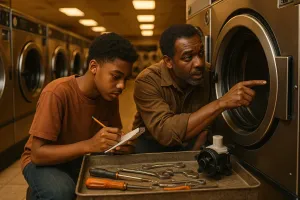

I was driving to the store the other day with boxes of equipment in the back of my car. Normally, I'd get there, unpack everything, and spend a few hours installing and configuring.
Halfway through the drive, something hit me.
"What the hell am I doing?"
I was listening to Peter Drucker's "The Effective Executive" on audiobook. He was talking about time and where it actually goes versus where we think it goes. And it clicked.
I don't need to set this up. We have managers. They have instructions. There are support videos. If they run into problems, they can call the vendor or check in with myself or my brother if they need clarification. Once they finish the setup, they move on to the next phase of implementing the system.
So that's what I did. Dropped off the boxes, emailed the documentation, and meet my brother to hand some other business matters.
Will they get it perfect the first time? Probably not. Will they figure it out? Absolutely. And now I'm free to focus on things that actually need me.
The Phrase We've All Heard
"Work on your business, not in it."
If you've read any business books or listened to any podcasts on entrepreneurship, you've heard this. The E-Myth made it famous. It gets repeated constantly.
It's good advice. But it's become background noise. We all nod along, then go right back to doing everything ourselves.
Here's the thing. Knowing the phrase doesn't change the behavior. Research shows business owners spend 68% of their time on operational tasks and only 32% on strategic work. And 73% of them say they'd prefer the inverse.¹
We know we should work on the business. We just don't.
Now, let me be clear. If you've built your operation a certain way and you want to stay hands-on, that's your call. Some of us genuinely enjoy the day-to-day work. That's a valid choice.
But this editorial is for those of us trying to move the needle. Those who want to step back from operations but haven't figured out how. Or maybe haven't even realized that's what's keeping us stuck.
What Drucker Actually Said
Here's where it gets interesting. Drucker didn't just say "delegate more." He said something that reframed everything for me.
"'Delegation' as a term is a misunderstanding. But getting rid of anything that can be done by somebody else so that one does not have to delegate but can really get to one's own work. That is a major improvement in effectiveness."²
Read that again.
Traditional delegation works like this, a task comes to you, you assign it to someone, you oversee their work, they report back, you approve or correct. The task still flows through you. You're still in the loop.
Drucker's approach is different. It's not about managing handoffs. It's about removing yourself from the loop entirely.
The equipment setup at my store? That's no longer a task I delegate. It's a task that belongs to someone else. Period. They don't report back to me for approval. They own it.
That's the distinction most of us miss. We think we're delegating when we're really just adding management overhead to our plate.
This Connects to Strengths
Drucker had another principle that ties directly to this, build on strengths, yours and your team's, rather than trying to fix weaknesses.
If someone on your team is strong at something, let them own it completely. Don't assign it and supervise. Hand it over and get out of the way.
The research backs this up. Gallup studied over a million employees and found that managers who focus on strengths see 67% engagement rates. Managers who focus on weaknesses? 2%.³
Two percent.
Drucker pointed to Japanese corporations as an example. They treat matching their best people to the best opportunities as a major HR function. They're not trying to shore up weak spots. They're amplifying what's already working.⁴
The mindset shift isn't "how do I delegate this task?" It's "who should own this entirely?"
What This Actually Looks Like
Let me get specific about what changed after that drive.
The equipment setup now lives with one of my managers. It's theirs. They have the vendor's support number. They have the documentation. They can check in with me or my brother if they need clarification, but the task belongs to them.
Same thing happened with several other tasks I was holding onto. Inventory ordering. Scheduling adjustments. Certain client issues. I stopped asking "who can handle this for me?" and started asking "who can own this without me?"
The fear is always the same, "Will they do it as well as I would?"
Maybe not at first. But they'll get there. And here's something many owner/operators don't want to hear, they might do it better than you.
We have this thing in our heads that no one's going to do it as well as us. That's ego talking. There are people out there who can do it way better than you. Your job is to find them and empower them by putting the task in their hands.
Here's what I've come to believe. As owner/operators, we need to get comfortable saying "I don't know, let me check with the person on my team who handles that."
Some people think that's a weakness. It's your business, you should know everything.
I see it differently. That's a flex. That means you've built something that doesn't require you to hold every answer. That's growth. That's what success actually looks like for a small or mid-sized business owner.
The alternative is you stay stuck doing everything forever, wondering why you can't seem to work on the business instead of in it.
The Pattern Most of Us Are Stuck In
The data on this is eye-opening.
Business owners work an average of 49 hours a week but believe they should work 42. Yet 85% expect nothing to change.⁵ And honestly, 49 hours seems low. I know owner/operators putting in way more than that every week. To be clear, we're talking about working in the business, not on it. That's the time that drains you.
Here's where the time actually goes, 36% disappears into administrative tasks.⁶ Small business owners average just 1.5 hours of truly productive, uninterrupted time per day.⁷
Harvard Business Review found that when knowledge workers identified low-value tasks to drop or hand off entirely, they reclaimed about one full day per week.⁸
One full day. Just by getting honest about what doesn't need to flow through them.
Drucker identified this pattern over 60 years ago. Most of us are still trapped in it.
The day you realize you're not the best at everything in your business, and you put those things in someone else's hands, is the day you stop being part of the system and start owning the system.
Thinking about the thinking of laundry:
When you realize someone can do 3/4 of the things in your business better than you, you’ve arrived.
What This Means for Your Business
This week, look at your task list with one question, who could own this, without me in the loop?
Not "who can I assign this to." Who can own it?
If you want to go deeper, I'd recommend checking out "The Effective Executive." Audiobook or print, either works. Most of us probably won't, and I get it. But if any of this resonated, it's worth the time. The book is from 1967 and still hits harder than most business content published today.
The shift isn't about delegating more. It's about owning less.
That's all I got for you today.
Waleed
Echoing the thoughts of Peter Drucker.
There is nothing so useless as doing efficiently that which should not be done at all.
Footnotes:
¹ The Alternative Board, "Time Management and Business Owners Survey," 2024. https://www.thealternativeboard.com/time-management
² Peter Drucker, "The Effective Executive," 1967. https://www.amazon.com/Effective-Executive-Definitive-Harperbusiness-Essentials/dp/0060833459
³ Gallup, "Strengths-Based Employee Development: The Business Results," 2024. https://www.gallup.com/workplace/236297/strengths-based-employee-development-business-results.aspx
⁴ Peter Drucker, "What Makes an Effective Executive," Harvard Business Review, 2004. https://hbr.org/2004/06/what-makes-an-effective-executive
⁵ The Alternative Board, "Time Management and Business Owners Survey," 2024. https://www.thealternativeboard.com/time-management
⁶ Time etc, "The Big Price of Small Tasks," 2023. https://www.timeetc.com/resources/how-to-achieve-more/the-big-price-of-small-tasks-how-entrepreneurs-may-be-unwittingly-keeping-their-businesses-small
⁷ Slack/Salesforce, "Small Business Productivity Survey," 2024. https://www.salesforce.com/news/stories/small-business-productivity-trends-2024/
⁸ Julian Birkinshaw and Jordan Cohen, "Make Time for the Work That Matters," Harvard Business Review, 2013. https://hbr.org/2013/09/make-time-for-the-work-that-matters