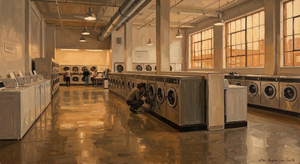
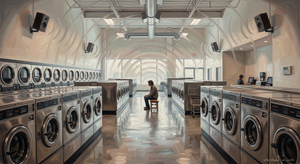
I was at the store recently to fix something in the POS system.
While I was there, I noticed one of the team members walk over, pick up their phone that was plugged in and charging near the device that controls the store's music, make a comment about the song, and switch the station. Whatever was playing before, gone. What came on next was their preference. Their genre. Their mood.
I watched for several minutes. The team member was into it. Head bobbing a little while they worked. The clients in the store didn't react. They weren't vibing. They were doing their laundry in whatever audio environment someone else had chosen for them in a split second.
That was one visit.
On a separate occasion, I walked in and the music seemed loud to me. Not blaring, but louder than it normally is. A couple of the team members were moving to it. They looked like they were enjoying their shift. The clients, again, just existed in it. Then at another time, a client mentioned to the manager that the music had been too loud. They didn't leave a review. They didn't make a scene. They said it in passing to the manager.
Three different visits. Three different observations. The same pattern.
Nobody was designing the client experience in that store. It was being shaped, day by day, shift by shift, by whoever had access to the controls.
The Invisible Revenue Lever
Here's where this gets interesting and blew my mind. There's a body of research, decades of it, on what happens when the atmosphere of a business is deliberately designed versus left to whoever has access to the remote, the thermostat, or the playlist.
A study analyzing 1.8 million restaurant transactions found that playing random popular music, the kind someone might stream from a personal playlist, decreased sales 4.3% compared to playing no music at all.¹ Read that again. Random music didn't just underperform good music. It underperformed silence.
A 56 week field experiment across eight fashion stores in Stockholm tested this directly.² Four stores played centrally managed, brand-aligned playlists. Four stores let employees choose between playlists of varying intensity. Over 4,626 sales observations, sales dropped 6% in the employee-controlled stores. The employees consistently picked higher-energy music, skipped slower songs, and turned up the volume. Their choices were the opposite of what the client base responded to.
Ronald Milliman ran a supermarket study back in 1982 that's still cited today.³ He alternated between slow-tempo music and fast-tempo music over nine weeks while holding everything else constant. Slow music: $16,740 in average daily sales. Fast music: $12,113. That's a 38% difference. Same store. Same products. Same staff. The only variable was tempo. And when shoppers were surveyed, they had no idea the music had influenced their behavior.
His follow-up in a restaurant showed the same thing.⁴ Diners with slow background music stayed 56 minutes versus 45 minutes with fast music. Those extra eleven minutes turned into three additional drinks per table and a 40% increase in bar revenue. Food orders didn't change. Tempo extended the visit, and the visit unlocked spending.
Now think about volume. A study found that restaurant checks averaged $21.63 when music was soft versus $18.57 when loud.⁵ The genre didn't matter. Only volume. In a survey of over 1,000 shoppers, half said they'd left a store because of the music.⁶ A Pandora CloudCover survey of 1,012 Americans found that a majority had left a business because music was too loud, and a quarter had left due to explicit or profane content.⁷
That last part is worth sitting with if you run a laundromat. If the playlist is in a language the owner doesn't speak, or if the lyrics are explicit, nobody's vetting what's being communicated in the store. This isn't about anyone's taste being wrong. It's about the owner/operator not knowing what message is playing on loop in their own business.
What Happens When They Leave
There's something specific about our industry that makes all of this hit differently.
Your clients have a built-in wait of 30 to 60 minutes give of take. That wait is either an asset or a liability depending on the environment they're sitting in.
When the atmosphere is right, clients stay. They wait with their clothes. They use the vending machines. They fold, reload, keep the flow moving. The store operates the way it's supposed to.
When the environment pushes them out, whatever the reason, they put their clothes in and leave. They figure they'll come back when the cycle is done. But they don't come back in 30 minutes. They come back in 50 0r 60.
Meanwhile, the machine has stopped. A new client walks in and needs that machine. It's sitting there full of someone else's clothes. Now the team member has to stop whatever they're doing, empty the machine, put the clothes in a cart, tag them, move them to a designated area. That ties up a cart. It disrupts whatever work they were doing. Their productivity drops.
Then the original client comes back. They see someone's touched their clothes. Maybe they're fine with it. Maybe they're not. "Where's the rest of my clothes? I had three machines. I only see clothes from two machines.” Now you've got a conversation, maybe a confrontation, over something that traces back to an environment that didn't give the client a reason to stay.
Nobody connects this to the music. Nobody connects it to the temperature. Nobody connects it to the general atmosphere of the store. But the research is clear, pleasant background music makes waiting periods feel shorter than silence.⁸ For a business whose entire client experience revolves around waiting, the atmosphere isn't decoration. It's operational infrastructure.
The Control Nobody Talks About
Music is the most audible example of this, but the same mechanism runs through every environmental control in your store. Temperature is the one that rarely gets discussed.
I've seen this play out even outside the store. In our office, there's a team member who walks in off the street on an 80 degree day, still hot from the walk, and immediately grabs the thermostat and turns it way down. Doesn't sit down first. Doesn't take off the jacket and let the body cool naturally. Just an immediate adjustment to make the room colder, without considering that other people have been sitting in there comfortably for hours.
He's solving his own discomfort in the fastest way available to him. That's the mechanism. When there's a control with no standard attached to it, whoever gets to it first designs the environment for themselves.
In the store, that same behavior plays out every day, except now it's happening to clients who have no say in it to a certain degree. .
The research on temperature and spending behavior is significant. A study published in the Journal of Consumer Psychology analyzed over six million shopping interactions and found that consumers in warmer environments were 46% more likely to engage with purchases and willing to pay at least 10% more compared to those in cooler settings.⁹ The researchers called it the "temperature premium." Warmth generates positive feelings, which increase how people value what they're experiencing.
Here's where the tension sits in a laundromat. Employees are on their feet. Mopping, folding, loading, cleaning. They're generating body heat. Their ideal comfort zone sits around 68 to 72 degrees. Clients are sitting. Waiting. Sedentary. Their comfort zone is closer to 74 to 77 degrees.¹⁰ When there's no standard, the person standing next to the thermostat all day sets the temperature for the entire store. And that person is the employee, not the client.
In the summer, dryers generate heat. Outside temperatures push the store hotter. Air conditioning becomes the battleground. And in stores that are unattended, nobody is there to monitor any of it. The thermostat, the music service, the lighting, all of it sits at whatever the last setting or programing is.
The Signal Nobody Sees
Years ago, at my dad's first store, we had two sets of lights, the window lights that faced the street and the interior store lights. After the last wash, we'd turn off the window lights. The dimmer exterior signaled that the last wash had passed.
The problem was that some team members started turning those window lights off 20, sometimes 30 minutes before the last wash. They were winding down. The shift was almost over. Turning off the lights was part of the closing routine, just not at the time they did it.
But people in the neighborhood knew those lights. They were conditioned by them. Light on, store is open. Light off, too late. They didn't check the time. They looked at the window.
Imagine someone getting home from work 30 minutes before last wash. They live a block away. They glance at the store and the window is dark. They think, "I missed it. I'll go tomorrow." They would've had made it with time to spare. But the signal said otherwise.
We never saw that client. We never knew they didn't come. The revenue quietly disappeared.
Rory Sutherland, the Vice Chairman of Ogilvy, wrote about this exact mechanism in his book Alchemy.¹¹ He described a cafe on a busy road that failed twice under two different owners. The third owner changed one thing, they put attractive, portable chairs and tables outside every morning. The cafe succeeded. Sutherland's insight was that the chairs were a reliable signal. From 300 yards away, a driver could see them and instantly know the cafe was open. The old fixed benches that sat outside permanently meant nothing because they didn't communicate anything. The portable furniture, the kind someone would bring inside if they closed, was proof of life.
Then someone wrote to Sutherland and shared the reverse.¹² They worked at a coffee shop and discovered that stacking just two chairs upside down on a table near closing time was enough to stop anyone from coming in. No sign change. No announcement. Just two upside-down chairs, and the last 15 minutes of business evaporated.
Two chairs on a table. A dark window at a laundromat. Same mechanism. Environmental cues that communicate "we're closed" before the business is actually closed, and nobody on the inside realizes what signal they're sending.
Why the Vacuum Always Gets Filled
None of this is about bad employees. Research on workplace behavior shows that 70 to 90% of employees personalize their workspace when given the opportunity.¹³ It's human nature. When there's a radio with no set station, someone sets it. When there's a thermostat with no policy, someone adjusts it. When there's a closing routine with no documented standard, someone creates their own version of one.
Psychologists call part of this status quo bias, the tendency to treat whatever was established first as the default and resist changing it.¹⁴ If the morning team member sets the radio to a station when they open, the afternoon team member often leaves it. Not because they love that station, but because the default has been set. And the employee who sets the station each morning is activating something researchers call psychological ownership.¹⁵ Through daily repetition, they begin to feel it's their dial to control.
The core issue is the comfort gap. The employee is optimizing for an eight-hour shift. The client is experiencing the space for 45 minutes. Those are fundamentally different relationships with the same environment. Without an explicit standard, the person who's there all day sets the terms for everyone who passes through.
Companies that take client experience seriously figured this out a long time ago. Starbucks has employed dedicated music curators for over 20 years, managing playlists that shift throughout the day.¹⁶ Employees can adjust volume and select from approved playlists but can't add personal music. Apple engineers every sensory detail of their retail stores, from the color temperature of the ceiling lights to the soundscape.¹⁷ These aren't accidental decisions. They're deliberate because these companies understand that ambient environment is part of the product.
If a controlled 56-week study can measure a 6% revenue decline from employees choosing the music in a fashion store, what's the combined effect in a laundromat where the same person also controls the thermostat, the volume, the lights, the closing routine, and the energy of the room, and nobody is measuring any of it?
Thinking about the thinking of laundry:
When you realize your team member is comfortable and your client isn't, you've answered the only question that matters about your store's experience.
Every store has a vibe. The question is whether you chose it.
That's all I got for you today.
Waleed
P.S. After three years and over 150 editorials, Wash Weekly is evolving. In the coming weeks, I'll be sharing what's changing and what's coming. Stay tuned.
Echoing the thoughts of Juhani Pallasmaa.
Every touching experience of architecture is multi-sensory; qualities of space, matter, and scale are measured equally by the eye, ear, nose, skin, tongue, skeleton, and muscle.
Footnotes:
¹ Brand-Fit Music Lifts Sales - Soundtrack Your Brand / HUI Research, 2017
⁵ The Effects of Music as an Atmospheric Variable on Consumer Behavior - Lammers et al.
⁶ Study: Annoying Music Drives Customers Away - Retail Customer Experience / Immedia, 2014
⁷ Optimizing In-Store Consumer Experiences - Pandora CloudCover Survey, 2019
⁸ Musical Tempo and Waiting Perceptions - Various Studies via Garlin & Owen Meta-Analysis
¹⁰ ASHRAE Standard 55 and Workplace Temperature Guidelines
¹² Is Everything BS? - Rory Sutherland, Behavioral Scientist, 2021
¹³ Workspace Personalization and Organizational Culture - Wells, 2000
¹⁴ Status Quo Bias - Samuelson & Zeckhauser, 1988 via InsideBE
¹⁶ Meet The Music Nerds Behind The Tunes You Hear At Starbucks - Fast Company, 2017
¹⁷ How Apple Strives for the Perfect Sky and Revives Cities - ArchDaily, 2019