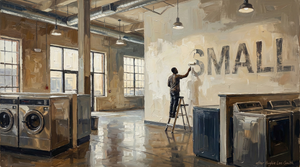
A while back, I was scouting locations in Pennsylvania. Part of my process is visiting laundromats in the area to get a feel for the market. I don't just drive by. I go in. I do laundry.
I pulled up to one and before I even opened the door, the business had already told me everything.
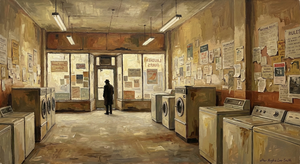
The windows were packed. Printed signs. Handwritten signs. Flyers from other businesses. Notices about services, community stuff, store rules, all layered on top of each other. Some on copy paper, some written in marker, some printed and taped up. The window looked like a bulletin board that hadn't been cleaned in years.
When I walked in, two attendants were off to the side talking to each other, looking at their phones. Neither looked up.
Then I saw the walls.
"Don't use dryers if you're not washing here." "Don't leave your clothes unattended." "Don't put bath mats in machines." "Don't use these machines for sneakers." A few machines had signs that said they were reserved for store use only, clearly for their drop-off work.
Here's what stuck with me. Nobody said a word to me. But that business had already had an entire conversation with me. And every single thing it said was either a warning, a restriction, or a "don't."
I wasn't a guest in that space. I was a potential problem they were preparing for.
Your Business Talks Before Your Staff Does
Every laundromat has a language. Not the language the owner thinks they're speaking. The language the client actually hears.
It starts before the door opens. A storefront that just says "Laundromat" is the equivalent of a hotel that just says "Hotel." It tells you nothing about what kind of experience you're walking into. It's a category label, not an identity. You've already told the client this is interchangeable with every other option in the neighborhood.
Then the windows. When they're packed with layered signs, papers, and flyers, the message isn't about what any individual sign says. The clutter itself is the message. It communicates disorder. It says, "We don't curate this space. We just tape things up when we think of them."
Then inside. The signs on the walls. The way the attendant does or doesn't acknowledge you.
None of these are neutral. Every single one is a positioning decision. The problem is most operators never consciously made these decisions. They just accumulated over time. A sign goes up because someone put sneakers in a dryer. Another sign because someone left clothes overnight. Another because the owner got tired of people using the bathroom without doing laundry.
Each sign made sense in the moment. But step back and look at the total picture, and you've built an environment that communicates one thing, we don't trust the people who walk through our door.
What "Don't" Actually Does
Here's where the psychology gets interesting.
In 1966, psychologist Jack Brehm identified something called reactance theory.¹ The concept is straightforward, when people feel their freedom is being restricted, they push back. They resist. Sometimes they do the exact opposite of what you're telling them.
A 2022 study published in Personality and Social Psychology Bulletin tested this across five separate experiments.² The finding was consistent every time. Messages framed as "Don't do X" triggered significantly more psychological resistance than messages framed as "Do X." And here's the part that should concern every operator with signs on their walls, the more official the sign looked, the stronger the resistance.
That professionally printed "Don't" sign isn't landing better than the handwritten one. It's landing worse.
Robert Cialdini ran a now-famous experiment at Arizona's Petrified Forest.³ A sign warning visitors not to steal petrified wood, framed negatively, more than doubled the actual theft rate. It went from 2.9% to 7.9%. The sign communicated that stealing was common, which normalized the exact behavior it was trying to prevent.
Think about what this means for a laundromat. A wall full of "Don't" signs doesn't just fail to stop the behavior. It tells every client walking in that the behavior is common enough to warrant a sign. You've just told them this is the kind of place where people put sneakers in dryers, leave clothes for days, and use machines they shouldn't.
You've defined your own environment by its worst moments.
The Ritz-Carlton Understood Something
The Ritz-Carlton and a budget motel sell the same core product. A room. A bed. A bathroom. A place to sleep.
The Ritz-Carlton charges $300 to $1,000+ a night. Budget motels charge $50 to $80.
Thread count and marble lobbies account for some of that gap. But the language system is where it starts.
At the Ritz-Carlton, employees aren't "staff." They're "Ladies and Gentlemen serving Ladies and Gentlemen," a phrase created by co-founder Horst Schulze.⁴ Clients aren't "customers." They're "guests" whose "expressed and unexpressed wishes" are anticipated.
Every employee is empowered to spend up to $2,000 per guest to resolve an issue without asking a manager.⁵ Problems aren't escalated. They're "owned and immediately resolved."
And here's the part that connects directly to our industry. The Ritz-Carlton has rules. Lots of them. But their documented approach is to never frame rules as restrictions on the guest. Their philosophy is that every policy should feel like something being done for the guest, not to the guest. Instead of telling people what they can't do, they frame the same boundaries as part of the service experience.
They don't have fewer rules than a budget motel. They have different language for the same rules.
I'm not saying your laundromat needs to be the Ritz-Carlton. That's not the point. The point is that the Ritz-Carlton proved something, language creates the experience. The physical product matters, but the words surrounding it determine how people feel about it. And how people feel determines what they're willing to pay and whether they come back.
Same Message, Different Feeling
Cornell University ran a six-week study in a restaurant.⁶ They took the exact same food and changed only the menu descriptions. "Red Beans with Rice" became "Traditional Cajun Red Beans with Rice." "Chocolate Pudding" became "Satin Chocolate Pudding."
Same kitchen. Same chef. Same ingredients. Same plate.
Sales increased 27%. Clients rated the identical food higher quality. Better value. More likely to return.
The words didn't change the product. They changed how people experienced the product.
Now read these two signs and notice what you feel:
"Don't put sneakers in the dryers."
Now read this one:
"Specialty items like sneakers and rugs? Ask our attendant for the best drying method."
Same intention. Same rule. One makes you feel managed. The other makes you feel helped.
One more:
"Don't leave clothes unattended. Not responsible for lost items."
Versus:
"We recommend staying with your laundry for the best experience."
The first one is a business protecting itself from you. The second one is a business looking out for you.
Now think about that attendant in Pennsylvania who didn't look up from their phone. What did that say? It said the same thing every "Don't" sign on the wall said, you're not important enough for us to engage with. The language of indifference is just as powerful as the language of restriction.
The Conversation You Didn't Know You Were Having
Here's what I think is worth considering.
Most operators I know didn't sit down one day and decide, "I want my business to feel cold and transactional." The signs accumulated. The clutter built up. The attendant habits formed without anyone noticing.
But the client doesn't see the history. They don't know that the "Don't put bath mats in machines" sign went up because someone destroyed a machine last month. They just walk in and feel the total weight of every "don't" on the wall.
That Pennsylvania laundromat didn't have bad machines. The store was functional. But the feeling I had walking through that door? I was being warned, not welcomed.
And here's the real question this raises, if changing the words on a restaurant menu, not the food, just the words, increased sales 27%, what's happening to your revenue when every word in your store says "don't"?
You might have the best machines in your market. The best location. The best prices. But if your language is working against you, from the storefront to the walls to the first words out of your attendant's mouth, you're undermining all of it without realizing it.
Thinking about the thinking of laundry:
When you realize your clientele is smarter than what the industry has painted them to be, you'll speak with them vs. talking at them.
If you've been reading Wash Weekly for a while, you know I'm a fan of walking into your own store like a client. This time, pay attention to something different. Read every sign, look at every window, and listen to what you feel. Not what you know as the owner. What you feel as a person walking through that door.
The Ritz-Carlton didn't eliminate rules. They changed the language. You don't have to take down every sign. You have to reconsider what those signs are saying on behalf of your business.
That's all I got for you today.
Waleed
Echoing the thoughts of Ludwig Wittgenstein.
The limits of my language mean the limits of my world.
Footnotes:
¹ Reactance Theory - Brehm, 1966
² Proscriptive Injunctions Can Elicit Greater Reactance - Personality and Social Psychology Bulletin, 2022
³ Cialdini Petrified Forest Experiment - Arizona State University
⁴ Ritz-Carlton Service Values and Brand Foundations
⁵ How the Ritz-Carlton Delivers Exceptional Customer Service
⁶ Descriptive Menu Labels' Effect on Sales - Cornell University, Wansink et al.